

[BTCFi Series 4] Technical Analysis and Comparison of Bitcoin Layer 2 Networks: Three Approaches Shaping BTCFi’s Future

Introduction – The Second Wave of BTCFi Experiments
Over the past few years, the Bitcoin ecosystem has pursued multiple paths to overcome on‑chain scalability and limited programmability. Layer 2 (L2) designs emerged to introduce smart contracts without changing Bitcoin Script directly. Notable lines of work include Stacks, Rootstock, and CoreDAO. These efforts enabled smart‑contract functionality anchored to Bitcoin’s security.
The latest L2 projects go further: rather than merely inheriting Bitcoin’s security, they aim to turn BTC from a passive store of value into productive capital that flows through real financial applications. The ecosystem’s technical direction is evolving toward BTCFi — decentralized financial infrastructure built around Bitcoin. This article analyzes three key approaches likely to shape BTCFi’s future and examines the technical architecture and implications of representative projects in each category.
Approach 1: Redesigning Bridge Trust Models
 These projects focus on rearchitecting how bridges custody and move BTC from Bitcoin L1 into L2s. Instead of relying on a small federation, they distribute trust or strengthen legal/technical transparency to mitigate single‑trustor risk.
1.1. Botanix: Decentralized Spiderchain Architecture
Botanix is a Bitcoin‑anchored L2 that introduces EVM programmability while inheriting security from Bitcoin. Its core is a unique decentralized bridge layer called Spiderchain. Spiderchain is not an independent sidechain; it operates as a collateral/custody layer between the L2 chain and Bitcoin L1.
When users deposit BTC to move value onto L2, funds are held in multisig wallets managed by Orchestrator nodes. A fresh multisig is created for every Bitcoin block, and its signers are randomly selected from Orchestrators using a verifiable random function (VRF) derived from the Bitcoin block hash. This continually rotating set reduces the concentration of trust compared with fixed federations.
On L2, a synthetic BTC is issued 1:1 against the deposit and used inside the EVM environment. For peg‑out, Spiderchain applies a Last‑In‑First‑Out (LIFO) policy to spend the most recent deposits first. Orchestrators must stake BTC and face slashing for malicious behavior, strengthening economic security. Full compatibility with Ethereum tooling makes it straightforward to port existing EVM dApps into the Bitcoin ecosystem. However, security still depends on operator honesty, and PoS dynamics may concentrate block production among large stakers — a centralization risk that must be managed.
1.2. BounceBit: CeFi+DeFi Hybrid with Transparent Custody
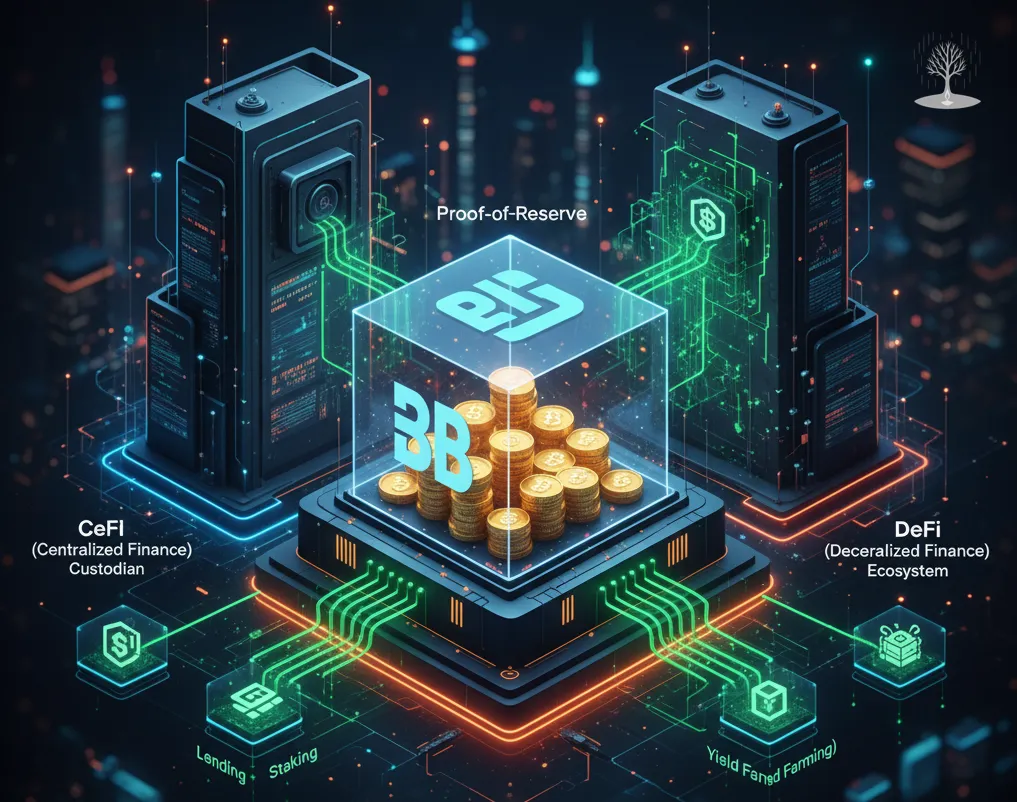
BounceBit is not a pure Bitcoin L2; it is closer to a hybrid infrastructure combining centralized finance (CeFi) and decentralized finance (DeFi). It targets Bitcoin’s “non‑productive liquidity” problem. BTC is custodied by regulated providers such as Ceffu and Mainnet Digital, and an on‑chain Liquidity Custody Token (LCT) called BBTC is issued. With BBTC, users can participate in a dual‑token PoS security model and also engage with DeFi yield opportunities (e.g., lending, staking).
Unlike opaque CeFi models, BounceBit emphasizes a “glass‑box” approach with Proof‑of‑Reserve to verify held BTC. This can attract institutional capital by aligning with compliance and transparency requirements. The trade‑off is fundamental custodial risk — assets are ultimately held by third‑party institutions, which introduces risks from hacks, insolvency, or mismanagement. From a self‑custody ethos, this approach prioritizes convenience and yield over pure decentralization, which is why BounceBit is typically not listed on “pure L2” trackers like L2BEAT.
Approach 2: ZK for Trust Minimization
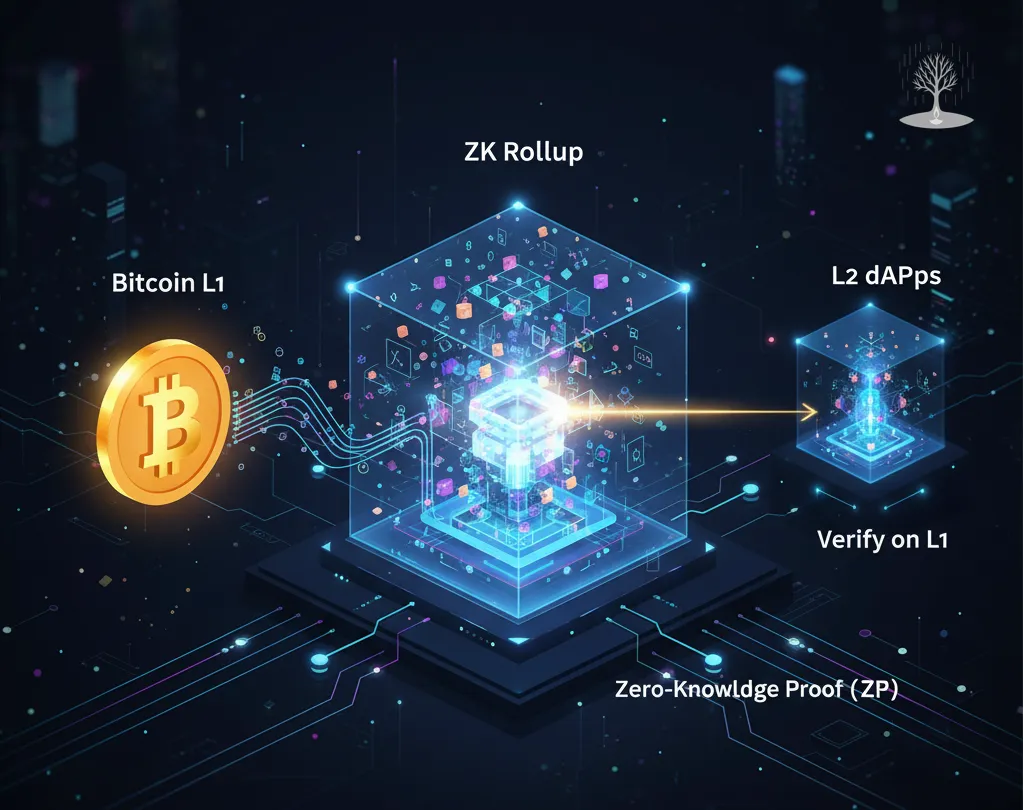
This category uses zero‑knowledge proofs (ZKPs) to mathematically remove bridge trust assumptions and inherit Bitcoin L1 finality as directly as possible — aiming at BTCFi’s north star: trust minimization.
2.1. BEVM: EVM‑Compatible ZK Rollup
BEVM is an EVM‑compatible Bitcoin L2 designed to bring the Ethereum dApp universe onto Bitcoin. A key piece is a decentralized cross‑chain bridge that leverages Taproot’s Schnorr signature aggregation, enabling a cleaner, more efficient alternative to traditional multisig custodians.
BEVM follows a “standard” ZK rollup architecture: a sequencer batches thousands of transactions off‑chain, generates a ZK proof attesting to their validity, and posts it to Bitcoin L1. The proof cryptographically guarantees the correctness of off‑chain execution while anchoring finality to Bitcoin. Using BTC as gas creates a native BTC demand sink, and EVM familiarity accelerates developer onboarding. The primary challenges remain ZK proof generation costs and implementation complexity at production scale.
2.2. zkBTC Family (Citrea, Bitlayer): Tight ZK–Bitcoin Integration
These projects pursue trust‑minimized rollups without protocol changes to Bitcoin L1, treating Bitcoin as both a data availability layer and the finality/security layer — the closest pattern to a “true” L2.
Citrea: BitVM‑Aided ZK‑SNARK Rollup
Citrea uses BitVM primitives to enable fraud‑proof‑like verification paths without upgrading Bitcoin consensus. Transactions are executed on L2, a ZK‑SNARK proof is produced, and the proof is recorded on Bitcoin L1. During peg‑out, the ZK proof is checked by a BitVM‑style verifier to authorize withdrawals. Compared with trust‑based bridges, this yields a security model grounded in cryptographic proofs rather than operator honesty — a strong defense against bridge hacks. The approach is promising but early; BitVM and production‑grade ZK remain fast‑moving targets.
Bitlayer: Dual Security via PoS and ZK
Bitlayer combines a fast PoS execution layer with a ZK rollup security layer. The PoS layer provides low‑latency blocks and low fees; rollup operators periodically batch state transitions, generate cryptographic proofs, and anchor them to Bitcoin for finality. Operator rotation mitigates centralization. Practically, it tries to blend PoS speed with Bitcoin PoW finality. Risks include residual centralization around operators and open questions around the exact ZK security envelope as implementation details mature.
Approach 3: Liquidity Platforms for a New BTC Role

Beyond scalability, these projects position Bitcoin as productive capital by liquidizing Bitcoin‑native assets (e.g., BRC‑20) and enabling diverse cross‑chain financial applications.
3.1. Merlin Chain: ZK Rollup with On‑Chain Fraud Proofs
Merlin Chain combines a ZK rollup, a decentralized oracle network, and an on‑chain BTC fraud‑proof module. Sequencers batch transactions and generate ZK proofs anchored to Taproot addresses on Bitcoin, thereby inheriting Bitcoin security. Merlin also collaborates with Celestia to ensure robust data availability (DA) for transparency and reliability.
Merlin’s strength is broad support for Bitcoin‑native assets like BRC‑20 and Ordinals, allowing it to rapidly aggregate liquidity. The “Merlin’s Seal” staking event reportedly pushed TVL above $3.5B at its peak; however, much of that was temporarily locked for the event rather than native L2 TVL, which hovered around ~500 BTC. Early critics also noted centralization risks such as an official bridge using a single‑signature address.
3.2. Mintlayer: Liquidity Without Wrapping
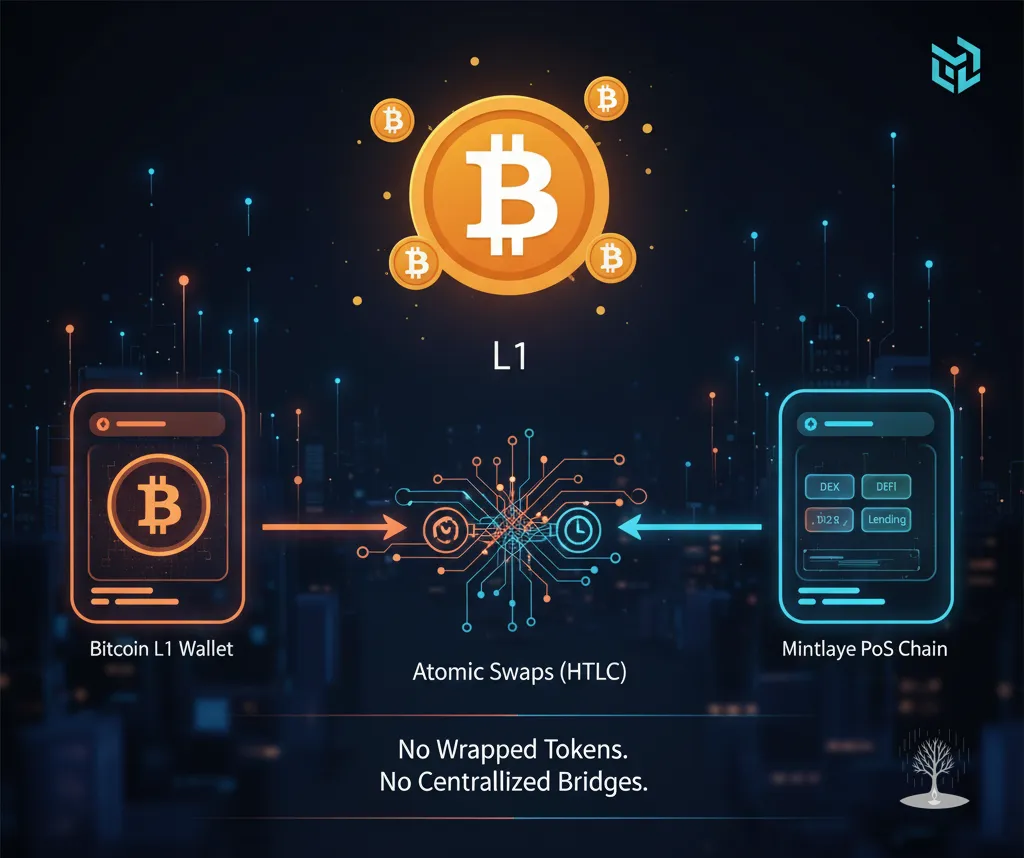
Mintlayer is an independent PoS sidechain that interoperates with Bitcoin without wrapped tokens. Its key primitive is HTLC‑based atomic swaps, enabling two parties to exchange assets across chains P2P without third‑party custody.
This design avoids custodial bridges and wrapped assets, eliminating a large class of bridge‑hack risks and achieving a high degree of decentralization. Unlike typical “lock BTC on L1, mint wrapped tokens on L2,” users keep BTC in their own L1 wallets and still participate in L2 DeFi via atomic swaps. Running nodes on modest hardware (even Raspberry Pi) furthers decentralization. The trade‑off is scope: atomic swaps are well‑suited for DEXs, but do not offer Lightning‑like payment scalability.
Conclusion – Diverse Experiments for BTCFi

Emerging Bitcoin L2s are not just solving scalability; they are redefining Bitcoin’s future role. Broadly, three approaches are taking shape: bridge‑trust redesign, ZK‑based trust minimization, and liquidity platforms that transform BTC into productive capital.
Botanix and BounceBit attempt to mitigate bridge centralization via different levers — distributed trust versus legal/operational transparency — highlighting a philosophical tension between decentralization ideals and capital efficiency. BEVM, Citrea, and Bitlayer push the trust envelope with ZK, removing human trust from the loop and aligning with Bitcoin’s trust‑minimization ethos. Merlin Chain and Mintlayer focus on liquidity, evolving BTC from static collateral into an asset that actively powers financial activity.
All are early and carry risks — centralization, custody, and implementation immaturity among them. But their outcomes will influence de‑facto standards and market direction, marking an inflection where Bitcoin moves from “digital gold” toward core financial infrastructure.
Comparative Table of Notable Bitcoin L2 Projects
| Project | Category | Consensus/Security | BTC Connection | VM Compatibility | Strengths | Risks |
|---|---|---|---|---|---|---|
| Botanix | Bridge‑trust experiments | PoS + inherits BTC PoW finality | Spiderchain bridge with rotating multisig orchestrators | EVM‑compatible | Ethereum tooling compatibility; BTC staking incentives | Operator trust assumptions; PoS centralization concentration |
| BounceBit | Bridge‑trust experiments | Dual‑token PoS (BTC + BB) | Custodied BTC with PoR; CeFi+DeFi hybrid | EVM‑compatible | BTC liquidity/yield; institutional‑grade transparency | Fundamental custodial risk; not a “pure L2” |
| BEVM | ZK experiments | ZK rollup | Taproot/Schnorr‑aided decentralized bridge | EVM‑compatible | Easy EVM dApp porting; BTC as gas | ZK proof cost/complexity; sequencer centralization |
| zkBTC (Citrea) | ZK experiments | ZK‑SNARK rollup | BitVM‑aided ZK proofs anchored on Bitcoin | zkEVM‑compatible | Trust‑minimized bridge; inherits Bitcoin security | Early BitVM/ZK maturity; production hardening |
| Bitlayer | ZK experiments | PoS + ZK (dual) | Operators submit ZK proofs for BTC finality | EVM‑compatible | PoS speed + BTC security | Residual operator centralization; unclear ZK envelope |
| Merlin Chain | Liquidity platforms | ZK rollup + on‑chain fraud proofs | ZK proofs anchored via decentralized oracle network | EVM‑compatible | Broad Bitcoin‑native asset support; high TVL | TVL composition questions; early bridge centralization |
| Mintlayer | Liquidity platforms | Independent PoS chain | HTLC atomic swaps, no wrapped BTC | Custom VM | Avoids bridge‑hack risks; high decentralization | Does not inherit BTC security; limited liquidity patterns |
Read next

[BTCFi Series 9] Babylon: TVL Up, Yields Thin
Babylon secures ~$5.6B in native BTC with a token worth ~$78M. The unit economics of Bitcoin security-as-a-service, and why realized yield stays thin.

[BTCFi 8] Clementine: BitVM in Production
Citrea's 2026 mainnet launched the first BitVM2 bridge. What the 1-of-N assumption requires, and where the model breaks under stress.
[BTCFi Series 6] Babylon vs EigenLayer Compared
A structural comparison of Babylon's Bitcoin-native staking and EigenLayer's ETH restaking — slashing, rewards, operator selection, and downstream effects.