

Babylon and the BTCFi Security-Extension Ecosystem: An In-Depth Analysis of the Financialization of Bitcoin Security

Introduction: Financializing BTC Security — The Dawn of a New BTCFi Paradigm
To bring smart contracts to Bitcoin, various Layer 2 solutions have emerged — from reusing Bitcoin L1’s consensus with auxiliary mechanisms to launching independent validator networks to achieve Turing completeness and scalability. Many of these, however, rely on their own validator sets or centralized bridges, and thus fail to fully inherit Bitcoin L1 security. Some have even warned that such L2s can be “parasitic” to L1. Despite being a roughly $2T asset, most BTC sits as idle capital and is not widely utilized as productive collateral in DeFi.
Babylon and the BTCFi ecosystem forming around it propose a fundamentally different approach. Instead of building a smart‑contract layer “on top of” Bitcoin to add functionality, Babylon experiments with monetizing Bitcoin L1’s security by renting it out to other PoS (Proof‑of‑Stake) networks in exchange for yield. Conceptually, this “lends” Bitcoin’s economic value to secure other chains, reframing BTC from “digital gold” into a foundational asset that supplies liquidity and security across the broader Web3 ecosystem.
This article takes a technical look at the leading experiments in this paradigm: Babylon’s native staking, liquidity and shared‑security expansions via Lombard and Satlayer, and projects like B² Network and Nubit that aim to complement Bitcoin L1’s technical constraints.
Babylon: Technical Innovation in Bitcoin‑Native Staking
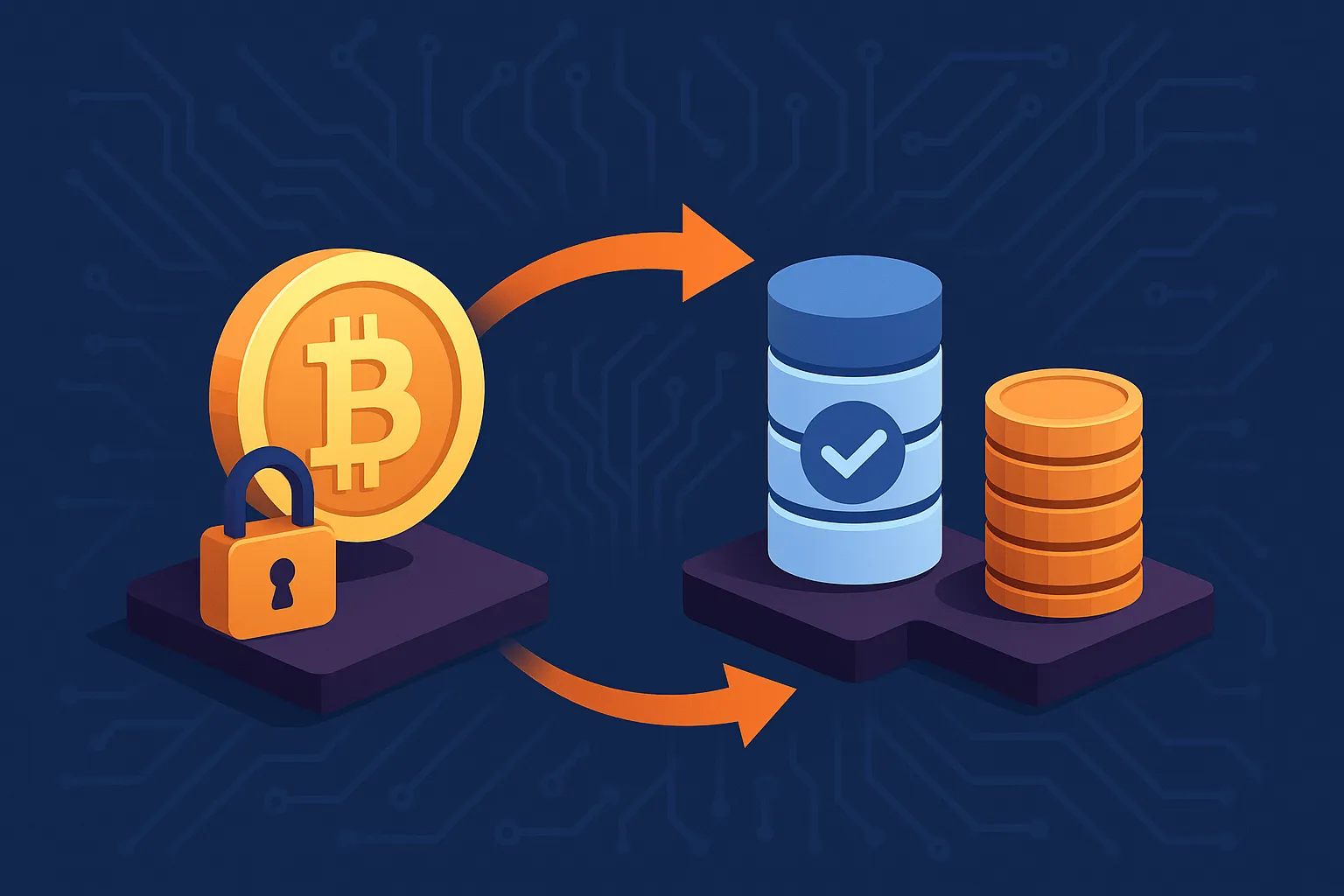
The Babylon protocol enables BTC holders to provide security to PoS networks and earn rewards without bridges or centralized custodians — while retaining custody of their assets. The core combines Bitcoin Script’s Time‑lock with an innovative signing scheme, EOTS (Extractable One‑Time Signatures).
Slashing Anchoring: Recording Slashing Events on BTC L1
Babylon’s key technique is a mechanism that enforces slashing for malicious PoS behavior (e.g., double signing) by anchoring evidence to Bitcoin L1’s immutability. The process:
-
Asset lockup: A staker locks BTC into a Taproot‑based UTXO with a
time‑lockscript. Withdrawals are only possible after a configuredunbondingperiod (e.g., 301 blocks, ~50 hours). The UTXO stays in the staker’s own wallet, preserving non‑custodial control. -
Key delegation: The staker delegates to a validator known as a
Finality Provider(FP). Using EOTS, the FP records the delegation on Bitcoin L1 and is authorized to sign PoS chain blocks. -
Equivocation detection and slashing: If an FP commits malicious behavior such as
equivocation(double signing), the EOTS mechanism derives and exposes the offending key to create aslashing transaction. A fixed portion (e.g., 0.1%) of the staked BTC from the FP and the delegator is burned. Importantly, Babylon does not slash for non‑malicious issues like downtime or missed votes — only double signing incurs a fixed penalty. -
L1 enforcement: The slashing transaction is recorded on Bitcoin L1, whose immutability guarantees the penalty cannot be reversed. In effect, PoS security violations are punished using Bitcoin’s credibility.
Extending State via Cosmos SDK Integration
Babylon operates its own L1 built with Cosmos SDK and interoperates with other Cosmos chains via IBC. This allows multiple PoS networks (Bitcoin Supercharged Networks, BSNs) to “rent” Bitcoin security and enables multi‑staking, where a single staked BTC can secure multiple PoS networks simultaneously and earn rewards from each — positioning Babylon as core infrastructure for Bitcoin staking.
Lombard: Expanding BTCFi via a Liquidity Layer

If Babylon is the base that monetizes BTC, Lombard turns staked BTC into a liquid derivative.
LBTC Issuance Design and Technical Safety
Built atop Babylon, Lombard is a restaking protocol. Users deposit BTC, which is staked through Babylon, and receive LBTC (Liquid Staked Bitcoin) at a 1:1 ratio. LBTC accrues staking rewards and can be used across DeFi — as collateral, for liquidity provision, lending, and more.
Because Bitcoin Script has limited expressiveness, Lombard augments on‑chain safety with off‑chain policy controls. Using Cubist’s hardware‑backed key‑management solution, Lombard enforces a policy engine: deposited BTC can only be used for staking; sensitive governance actions require multisig approvals and time‑locks. This preserves Bitcoin’s security guarantees while providing the standard safety controls expected from an LST protocol.
Strengths and Risks
Lombard addresses idle BTC and lets holders keep assets productive while earning staking rewards — amplifying BTC liquidity in a more decentralized way than centralized wrappers like wBTC. Risks include LBTC’s peg stability relative to BTC and the possibility that Babylon’s slashing risks propagate to LBTC holders.
Satlayer: A Bitcoin‑Based Shared‑Security Layer
Satlayer extends Babylon with Bitcoin restaking, broadening the scope of Bitcoin‑backed security. Similar to Ethereum’s EigenLayer, BTC staked via Babylon can be restaked to secure external protocols (Bitcoin Validated Services, BVSs) for additional rewards.
BVSs and Programmable Slashing
Satlayer’s core is programmable slashing. Whereas Babylon only applies a fixed penalty for double signing, Satlayer lets BVS developers define application‑specific slashing (e.g., downtime). Protocols can thus “rent” Bitcoin’s economic security without bootstrapping their own validator set or inflating a native token for security. This enables custom security for use cases like penalizing inaccurate oracle data or malicious AI services — enforced against BTC collateral.
Similarities to Cosmos Interchain Security (ICS)
Satlayer resembles Cosmos Hub’s ICS, where ATOM stakers lease security to appchains. Both leverage a larger validator set to secure smaller chains and reduce the overhead for new projects. Unlike ICS (centered on ATOM within Cosmos), Satlayer taps Bitcoin — the ultimate idle capital — to deliver shared security beyond the Cosmos ecosystem.
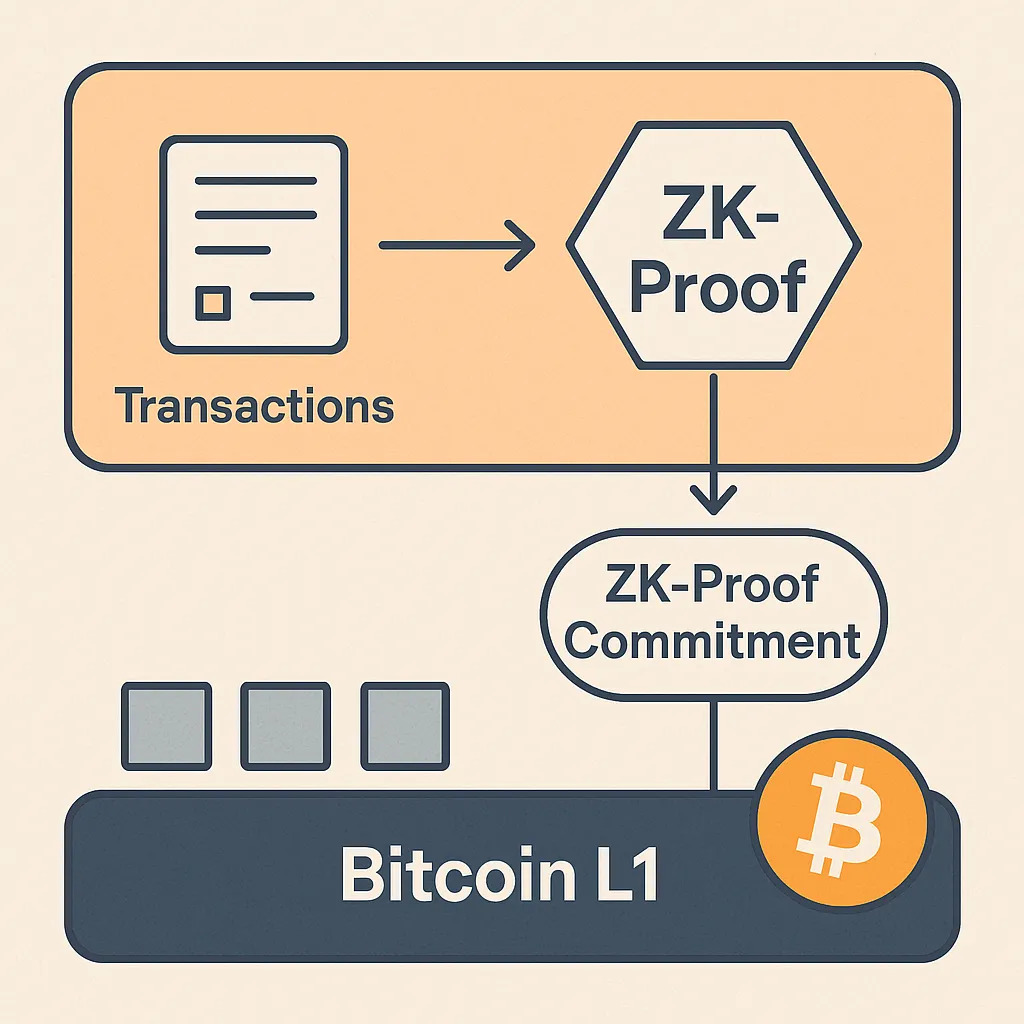
B² Network addresses Bitcoin L1’s lack of general programmability by recording commitments to verify ZK proofs on Bitcoin, rather than verifying proofs directly on L1.
-
Proof commitment: Off‑chain execution produces a
ZK proofof validity. The proof is transformed into anarithmetic circuit, then into a NAND‑gatelogic circuit. The resultingcircuit Taprootcommitment is recorded on Bitcoin L1. -
Challenge–response: Similar to optimistic rollups, a
Challengercan dispute an invalid commitment. -
MAST‑based dispute resolution: Using Taproot’s
MAST (Merkelized Abstract Syntax Tree), challengers can execute the script branch that reveals a fault. Successful challenges claim locked BTC as reward. Rather than verifying the full proof on L1, B² inherits security by anchoring commitments and adjudication on Bitcoin.
Nubit: Bitcoin‑Backed Data Availability (DA)
Data Availability (DA) ensures that data for off‑chain rollup transactions is published so anyone can reconstruct and verify rollup state. Nubit leverages Bitcoin blocks for DA to address rollup data‑publishing.
By anchoring transaction data to Bitcoin, Nubit uses data availability sampling (DAS) to let light clients efficiently verify availability despite Bitcoin’s limited block space (~4 MB). The approach parallels Celestia in Ethereum’s ecosystem.
Where Babylon anchors Bitcoin’s economic value, B² and Nubit anchor technical guarantees — proofs and data. Babylon unlocks idle capital; B² and Nubit complement Bitcoin L1’s limitations, forming a mutually reinforcing stack.
Differentiators of the Security‑Extension Ecosystem
Babylon, Lombard, and Satlayer differ from conventional L2s by directly using Bitcoin’s economic value to purchase or augment other chains’ security — turning BTC from passive store of value into ecosystem‑wide collateral.
| Project | Consensus/Security | Core Function | Strengths | Risks |
|---|---|---|---|---|
| Babylon | BTC‑native staking + PoS | Use BTC as security collateral for PoS chains | No bridge; non‑custodial; direct use of BTC security | UX complexity; community adoption; regulatory risk |
| Lombard | Babylon‑based LST issuance; Cubist policy controls | Convert staked BTC into LST (LBTC) | Amplifies BTC liquidity; couples with Babylon security | Peg stability; smart‑contract vulnerabilities |
| Satlayer | Bitcoin restaking via Babylon | Multi‑chain shared security; programmable slashing | Generalizes BTC security; custom security for dApps | Early adoption; governance concentration |
| B² Network | ZK rollup; ZK‑proof commitments on BTC L1 | EVM‑compatible rollup inheriting BTC L1 security | Scalability with Bitcoin finality; EVM compatibility | Implementation complexity; challenge‑system reliability |
| Nubit | Bitcoin DA layer | Anchor rollup data to BTC L1 | DA under Bitcoin’s immutability | L1 data costs; DAS efficiency |
Investor/Developer Perspectives
Investor Perspective
-
Babylon: Focus on sustainable staking yields and the credibility of the slashing model. Evaluate
Finality Provider (FP)reliability and manageslashing riskduring the unbonding period. -
Lombard: Track
LBTCliquidity growth and DeFi adoption. Assess peg stability, smart‑contract exposures, and whether Babylon slashing risks could spill over to LBTC holders. -
Satlayer:
SLAYtoken value likely depends on the success of Bitcoin restaking. Analyze real BVS adoption and early governance centralization risks. -
B² Network & Nubit: Early‑stage technology bets. For B², watch ZK proof maturity and real‑world challenge‑system reliability; for Nubit, DA competitiveness and the cost of recording on Bitcoin L1.
Developer Perspective
-
Babylon: Opens avenues for DeFi using Bitcoin‑native collateral. Cosmos SDK integration eases development; IBC enables cross‑chain interactions.
-
Lombard: Suits cross‑chain LST‑based apps around
LBTC— lending/borrowing protocols and liquidity pools using LBTC as collateral. -
Satlayer: Attractive for protocols needing custom security. Programmable slashing enables economic penalties (e.g., for oracle misreports) enforced against BTC collateral.
-
B² Network & Nubit: Good fit for EVM‑compatible rollups or data‑intensive apps that inherit Bitcoin security. B² supports Ethereum tooling like
HardhatandFoundry, lowering migration friction.

Conclusion: The Dawn of the BTC Security Paradigm
Babylon and its ecosystem are a historic attempt to transform BTC from a passive store of value into productive capital underpinning Web3. This is not just functional expansion via L2s; it is the financialization of Bitcoin’s economic value.
Lombard supplies a liquidity layer; Satlayer broadens the scope through shared security. B² Network and Nubit explore scalability from different angles — rollups and DA — while preserving Bitcoin’s core properties (security, immutability). Together they seek to harness Bitcoin’s value without diluting its essence.
BTCFi’s future likely crystallizes where smart‑contract expansion (Stacks, RSK) meets security financialization (the Babylon stack). If Bitcoin L1 security undergirds PoS ecosystems and the resulting liquidity drives on‑chain activity like DeFi, BTC can move beyond “digital gold” and into the role of foundational financial infrastructure for Web3.
Read next

[BTCFi Series 9] Babylon: TVL Up, Yields Thin
Babylon secures ~$5.6B in native BTC with a token worth ~$78M. The unit economics of Bitcoin security-as-a-service, and why realized yield stays thin.

[BTCFi 8] Clementine: BitVM in Production
Citrea's 2026 mainnet launched the first BitVM2 bridge. What the 1-of-N assumption requires, and where the model breaks under stress.
[BTCFi Series 6] Babylon vs EigenLayer Compared
A structural comparison of Babylon's Bitcoin-native staking and EigenLayer's ETH restaking — slashing, rewards, operator selection, and downstream effects.