

[BTCFi Series 2] The Wave Driving BTCFi: L2s and Babylon Native Staking

Introduction
In recent years, the Bitcoin ecosystem has undergone explosive change. Meta‑protocols like Ordinals and BRC‑20 transformed Bitcoin from “digital gold” into a richer “data layer.” By inscribing arbitrary data such as images and text, we could issue assets and form communities on BTC L1, but the capabilities still fell short compared to other DeFi ecosystems.
These meta‑protocols used the Bitcoin blockchain effectively as a data store, but they could not process complex state management and verification logic purely on‑chain. Balances and transfers for BRC‑20 ultimately live in off‑chain indexers that interpret transactions under their chosen rules. This assumes that indexers share the exact same rules and versions; when that assumption is broken, consistency collapses. The “data innovation” succeeded, but we did not reach smart‑contract‑level guarantees. We need a new execution layer that provides security, finality, and automated verification — not just data anchoring on Bitcoin.
Approaches to BTC L2
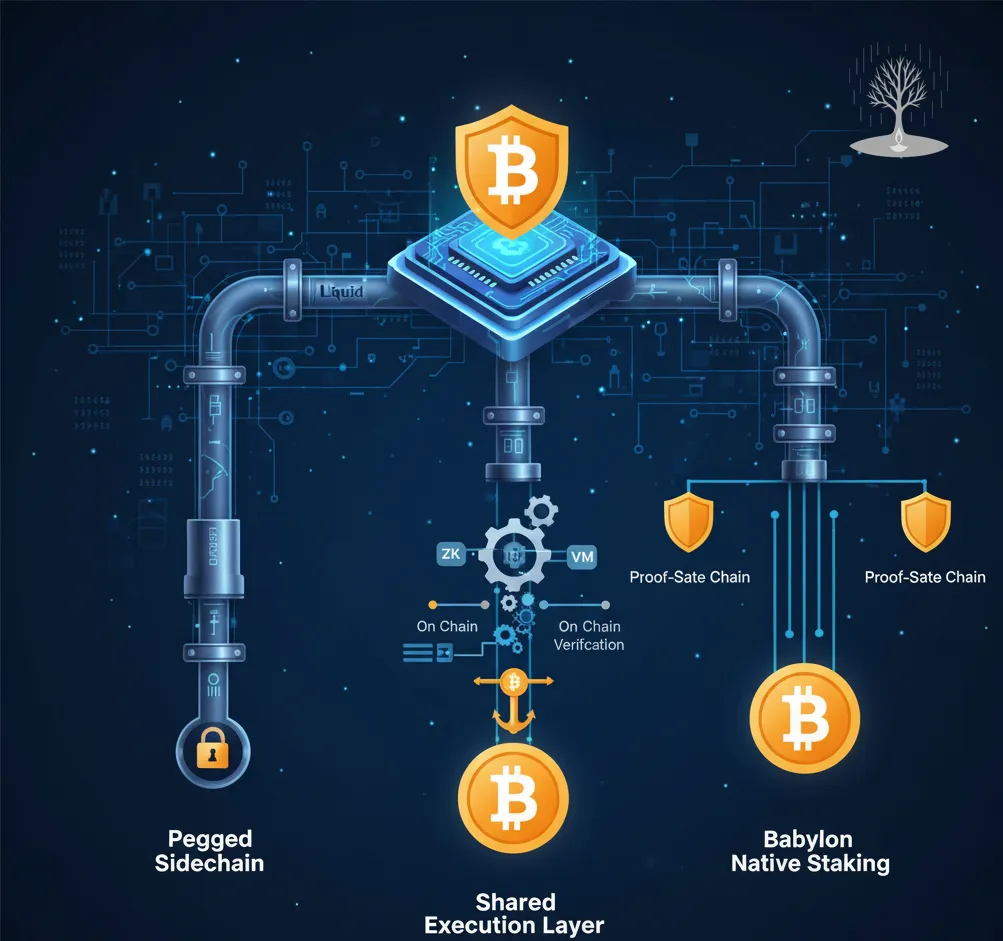
As the need for L2s became clear, three broad approaches emerged.
-
Pegged Sidechains: Liquid wraps BTC and moves it to a separate sidechain to gain speed and scalability. However, asset movement and security are managed by a small federation of operators. Even with multisig, this compromises Bitcoin’s core values of decentralization and censorship resistance. The UX and speed, however, are strong.
-
Bitcoin Rollups: Projects like Citrea attempt on‑chain fraud/validity proofs over Bitcoin’s non‑Turing‑complete Script using BitVM. Many BTC L2s anchor validity to Bitcoin by combining ZK rollups with BitVM‑based verification. Still, to bring liquidity into DeFi, these systems generally rely on wrapped BTC (e.g., cBTC), which carries its own trust and bridging constraints.
-
Babylon’s Native Staking: Babylon takes a very different route. Without wrapping or bridging BTC off L1, it uses on‑chain Script plus cryptography to secure external PoS networks via “native staking.” This turns BTC from a passive store of value into productive collateral. Given BTC maximalists’ aversion to custody risk, this is a compelling approach.
Notably, these are not mutually exclusive. They can be synergistic. For example, BOB (Build on Bitcoin), a BitVM‑oriented L2, leverages BitVM’s strength for on‑chain validity while partnering with Babylon to connect L2 transaction finality back to Bitcoin L1. If BitVM strengthens security around wrapped BTC validity, Babylon can underwrite L2 block finality with Bitcoin’s massive security budget. This suggests Babylon is evolving beyond “native staking” into a shared security layer for execution layers on Bitcoin — akin to modular blockchain trends in Ethereum — acting as a gravitational hub for BTCFi.
How Babylon’s Native Staking Works
Babylon’s “native staking” cleverly combines Bitcoin L1 Script with modern cryptography. The core requirement, both for security and for holders, is that each wallet’s BTC does not move off L1; let’s unpack the mechanism.
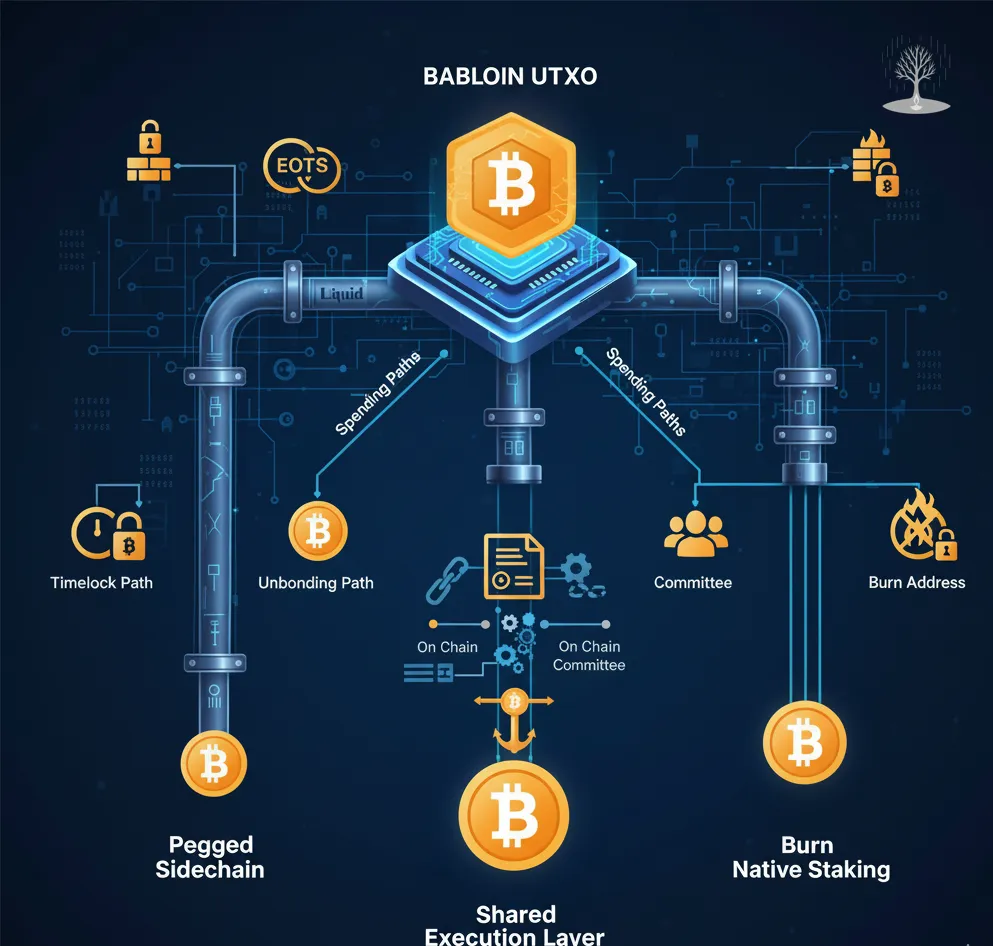
2.1. Three‑Path Taproot UTXO Design: Babylon staking defines three conditional spending paths inside a Taproot UTXO on Bitcoin L1, allowing BTC to remain in the owner’s wallet on L1 while being staked.
- Timelock Path: After a set number of blocks, the staker can withdraw freely.
- Unbonding Path: Early unbonding before expiry requires, in addition to the staker’s signature, signatures from a covenant‑emulation committee, enforcing protocol‑defined unbonding rules.
- Slashing Path: If a Finality Provider (FP) equivocates (e.g., double signs), a preset portion of BTC is moved to a burn address. This path is enabled via pre‑signatures from the staker, the FP, and the committee.
2.2. EOTS‑Based Slashing: Babylon’s slashing uses Extractable One‑Time Signatures (EOTS) and adaptor signatures. If an FP signs two conflicting messages at the same height, properties of EOTS reveal the FP’s private key, which finalizes a pre‑built slashing transaction that atomically moves a fixed fraction of BTC to a burn address.
This sidesteps some verification limits of Bitcoin L1, but has trade‑offs: only equivocation is slashable. Non‑malicious faults such as downtime or missed votes are not penalized, concentrating operational risk on FPs and making professional key‑management solutions (e.g., Cubist) important.
2.3. Covenant Emulation Committee: Bitcoin Script cannot directly enforce covenants. Babylon augments enforcement with an M‑of‑N multisig committee that pre‑signs transactions to emulate covenant‑like rules for early unbonding and slashing.
This is a pragmatic workaround to Script limits but raises transparency concerns. Without committee co‑signatures, early unbonding is impossible. While the committee cannot seize funds without the staker, collusion to withhold signatures could threaten liveness. Today, committee identities are not publicly disclosed, underscoring the explicit trade‑off: adopting some centralized trust to enable richer functionality while aiming for progressive decentralization.
2.4. Finality via Checkpointing: Babylon’s genesis chain (Cosmos SDK + CometBFT) aggregates validator signatures using BLS and periodically anchors a single aggregated checkpoint signature into Bitcoin L1 via OP_RETURN.
This taps Bitcoin’s security to bolster Babylon’s finality while minimizing on‑chain data. It also explains why BitVM‑based L2s like BOB use Babylon as a finality layer.
Table 2: Key Components of Babylon Native Staking
| Component | Description | Role | Key Risks |
|---|---|---|---|
| Three‑Path UTXO | Timelock, Unbonding, Slashing paths embedded in a Taproot spend. | Keep principal on L1; enforce conditional withdrawals. | Script bugs; path activation failures. |
| EOTS Slashing | Cryptography that reveals keys on equivocation. | Immediate, atomic penalty for double signing by FPs. | No penalty for downtime; FP key‑management risk. |
| Covenant‑Emulation Committee | M‑of‑N multisig pre‑signs to enforce rules. | Compensate for Script limits; enforce protocol policies. | Collusion risk; liveness and trust assumptions. |
| BLS Checkpointing | Aggregate validator signatures to anchor on L1. | Strengthen finality using Bitcoin security. | Aggregation errors; L1 synchronization issues. |
Economics and Ecosystem Strategy
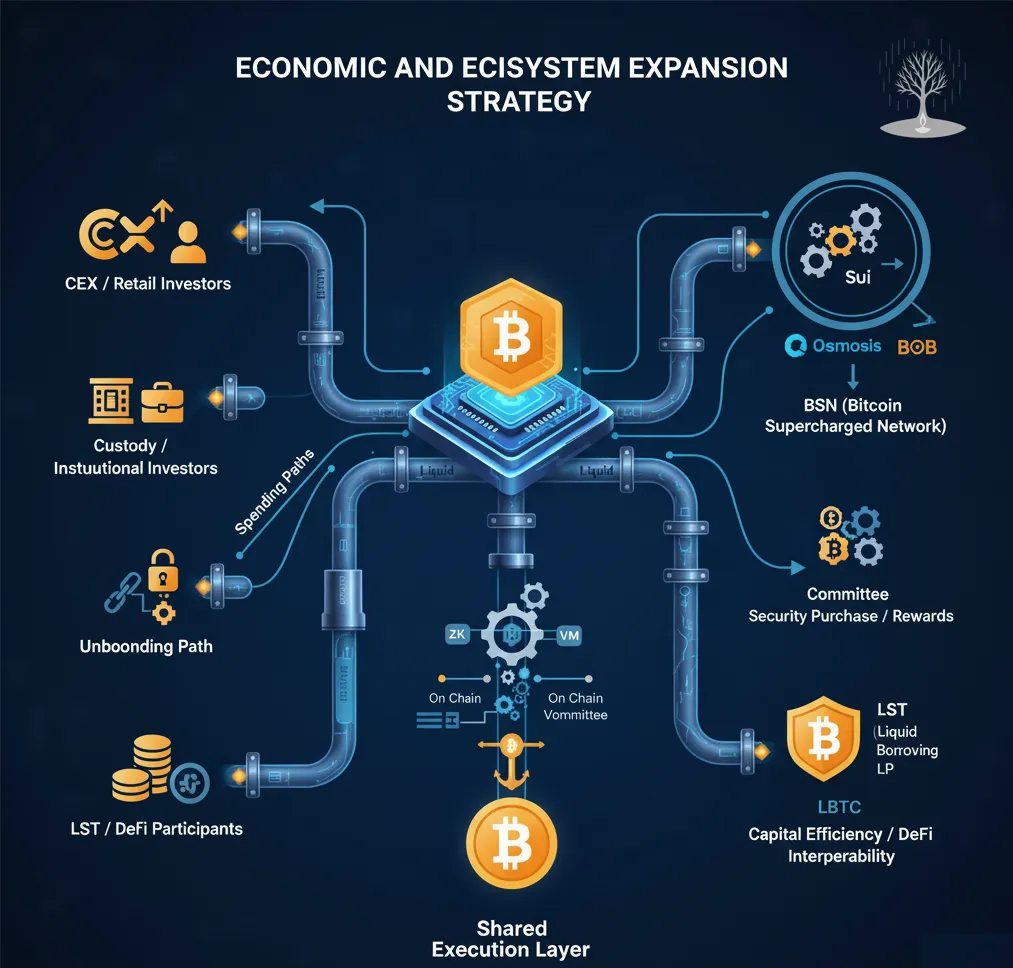
Babylon aims to be more than a protocol: a hub for mobilizing BTC liquidity in many forms.
3.1. Who Stakes BTC, and Why?
Traditional BTC holders prioritize preserving coin count and shun risk. Babylon enables staking while coins remain in the holder’s L1 wallet, nudging some holders to participate. To broaden access, Babylon supports several channels:
- Individual Investors: Centralized exchanges such as Kraken provide easy access. Without wrapping or bridging, users can stake as simply as a typical PoS asset. Rewards are paid in BABY (and, over time, BSN rewards).
- Institutions: Custodians such as Anchorage and Hex Trust provide regulated, secure channels aligned with institutional needs for compliance and long‑term BTC strategies.
3.2. BSN — Bitcoin Supercharged Network: Babylon’s core business lets PoS chains “buy” Bitcoin’s security. These chains, collectively the BSN, reward Babylon stakers with their native tokens. BSN chains solve cold‑start problems, shorten unbonding, and dramatically raise attack costs.
Examples highlight the potential:
- Osmosis: As a condition for becoming BSN, proposes distributing 50% of taker fees from Babylon‑ecosystem assets to Finality Providers (FPs). This is a concrete model for “purchasing PoS security” and a likely revenue lane for Babylon.
- Sui: Shows Babylon’s modularity by integrating with Sui’s DAG‑based consensus — the protocol is not tied to any one stack.
- BOB (Build on Bitcoin): A BitVM rollup using Babylon for finality. BOB expands liquidity via Babylon‑backed LSTs and anchors stability in Babylon’s security.
3.3. Activating LSTs: Capital Efficiency: Staked BTC is illiquid during lockup. Lombard issues an LST, LBTC, backed 1:1 by Babylon‑staked BTC with rewards accruing. Users can then deploy LBTC across DeFi — collateral, lending, LPing — maximizing capital efficiency.
Table 3: Comparison by Partner/Channel
| Channel | User Type | Staking Method | Unbonding Policy | Key Benefits |
|---|---|---|---|---|
| CEX (Kraken) | Individuals | Exchange‑delegated (custodial) | ~7 days | Easy access; simple UX. |
| Custody (Anchorage, Hex Trust) | Institutions | Professional custodian delegation | ~7 days | Security and compliance; tailored services. |
| LST (Lombard, Nomic) | DeFi users | Protocol delegation (LST issuance) | Instant liquidity by selling LBTC | Max capital efficiency; DeFi composability. |
Challenges Ahead for Babylon
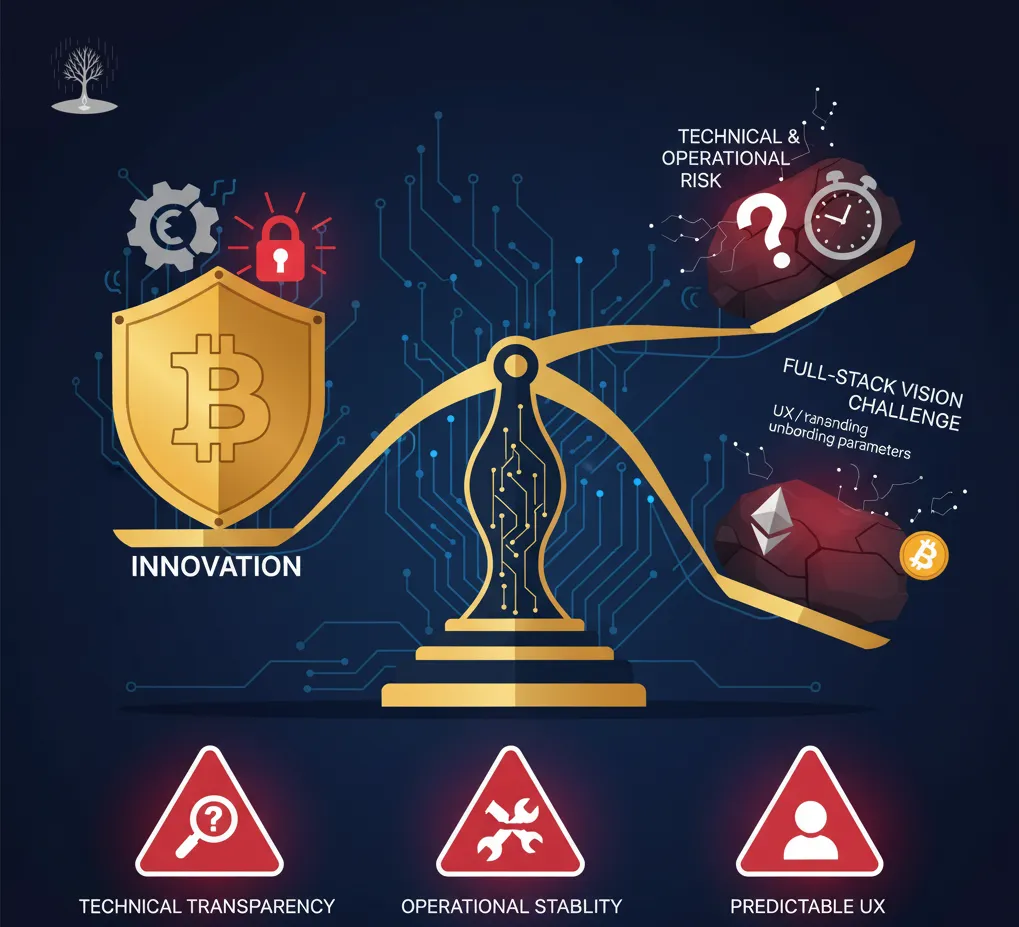
Babylon is clearly innovative, but several challenges remain.
4.1. Technical/Operational Risk: EOTS‑based slashing imposes strong penalties for double signing, meaning FPs face immediate slashing due to key mishandling or software bugs. Operational robustness directly ties to asset safety, making professional key management (e.g., Cubist) essential.
4.2. UX/Transparency: Unbonding Confusion: A key advantage is “fast unbonding.” Official docs cite 301 blocks (~50 hours), while partners like Kraken and Hex Trust indicate ~7 days or 1,008 blocks. Beyond documentation timing, CEXs may add internal delays for liquidity or security. Unbonding parameters are protocol‑level and can change via BABY governance, creating unpredictability that harms UX and highlights tension between technical transparency, commercial partnerships, and governance policy.
4.3. Full‑Stack Vision: Beyond staking, Babylon aims to support EVM and host BTC‑native DeFi apps — a “full‑stack BTCFi hub.” This puts Babylon in more direct competition with Ethereum L2s and demands attracting significant liquidity and developers.
Conclusion
Babylon has awakened BTC’s liquidity and productivity — “capital that moves security/rewards without moving coins (no bridge).” This paradigm turns BTC into productive capital.
By keeping BTC on L1 and combining EOTS slashing, native Script, and a pragmatic external committee, Babylon opens a door to “Bitcoin DeFi” previously thought impossible — likely a major catalyst for the ecosystem.
But key gaps remain:
- Technical Transparency: Publish a decentralization roadmap and identities for the covenant committee to progressively reduce centralized trust assumptions.
- Operational Resilience: Broaden secure key‑management options for institutional and individual FPs to reduce operational risk.
- Predictable UX: Clarify unbonding parameters and reward policies to reduce confusion.
Babylon is becoming a core of BTCFi. For its full vision to become reality, progress on decentralization, transparency, and user experience must accompany the technical breakthroughs.
Read next

[BTCFi Series 9] Babylon: TVL Up, Yields Thin
Babylon secures ~$5.6B in native BTC with a token worth ~$78M. The unit economics of Bitcoin security-as-a-service, and why realized yield stays thin.

[BTCFi 8] Clementine: BitVM in Production
Citrea's 2026 mainnet launched the first BitVM2 bridge. What the 1-of-N assumption requires, and where the model breaks under stress.
[BTCFi Series 6] Babylon vs EigenLayer Compared
A structural comparison of Babylon's Bitcoin-native staking and EigenLayer's ETH restaking — slashing, rewards, operator selection, and downstream effects.