


Introduction: Awakening Bitcoin’s Dormant Liquidity
Bitcoin has firmly established itself as a store of value. Predictable issuance, strong security from proof‑of‑work (PoW), and censorship resistance are its core virtues. Despite a market cap around $900B, most BTC sits idle in wallets — the “sleeping giant.” While long‑term holding supports price stability, liquidity circulation has been limited.
As Bitcoin remained largely in a hold‑only role due to conservative protocol design and limited on‑chain expressiveness, Ethereum built a vast DeFi economy around smart contracts: lending, derivatives, stablecoins, and AMMs interoperate seamlessly. The technical movement to unlock Bitcoin’s liquidity without compromising its fundamentals is what we call BTCFi.
Bitcoin’s Fundamental Constraints: Script and the UTXO Model
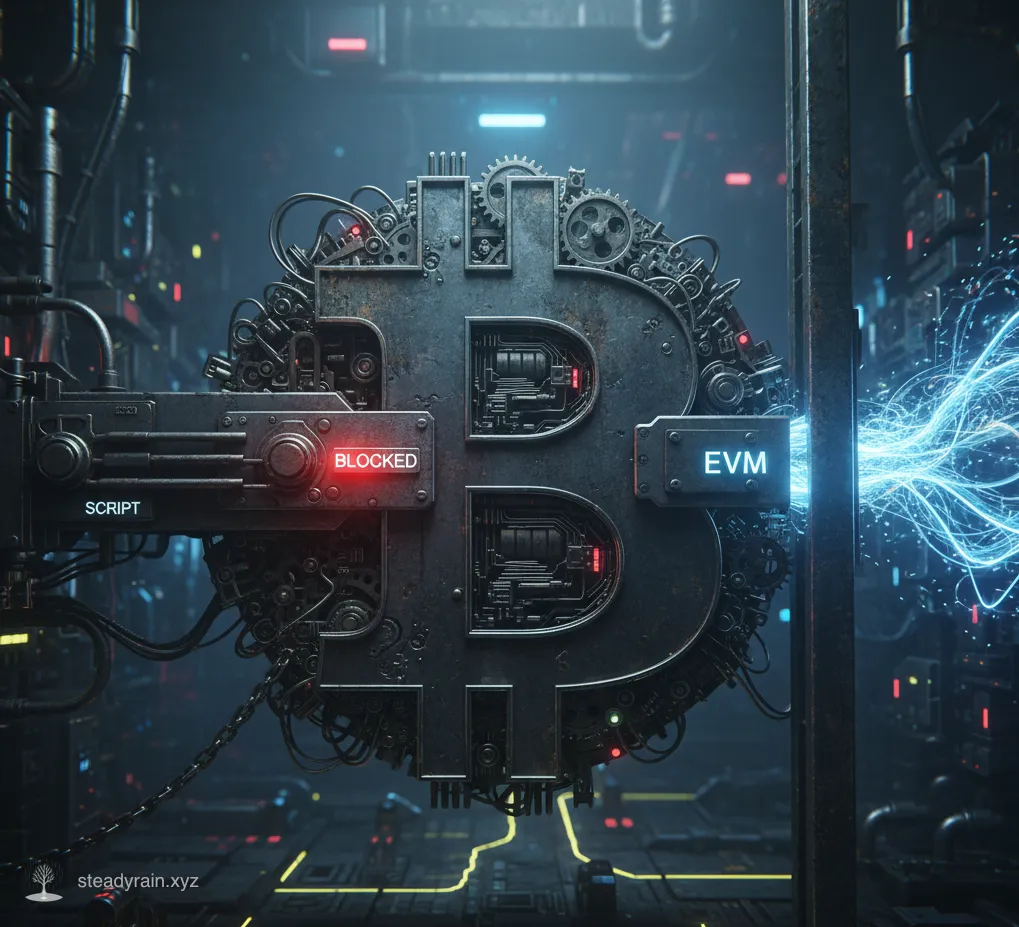
Bitcoin’s core constraints stem from its Script and the UTXO (Unspent Transaction Output) model. Bitcoin Script is a stack‑based, deliberately non‑Turing‑complete language that disallows loops and arbitrary state mutation — a choice made for security and ease of verification. Transactions are validated without a global state; inputs, outputs, and script evaluation suffice.
This UTXO model contrasts with Ethereum’s account model. Ethereum maintains balances, nonces, and storage as global state updated directly by contracts, whereas Bitcoin represents value as independent fragments called unspent outputs.
The differences yield opposing trade‑offs in performance, privacy, and applicability.
-
Advantages: Strong independence between transactions enables parallel verification; with prudent address reuse, privacy improves; and double‑spend prevention is straightforward.
-
Drawbacks: Workloads requiring shared, mutable state become difficult. For example, a collateral lending pool needs concurrent access and updates by many users. In a UTXO system, a single “pool state” UTXO cannot be consumed by multiple transactions simultaneously, creating a concurrency bottleneck. As a result, rich, general‑purpose DeFi is hard to implement directly on Bitcoin L1.
The New Wave That Stirred the Giant: Ordinals and BRC‑20

Launched in 2023, Ordinals and BRC‑20 injected fresh energy into BTCFi. Ordinals assign sequence numbers to satoshis (the smallest BTC unit) and “inscribe” arbitrary data (images, text) into the expanded witness space.
This introduces a meta‑protocol that carries structured data in transactions without changing Bitcoin Script itself. BRC‑20 leverages this to define token rules — deploy, mint, transfer — via a JSON schema. Indexers analyze transactions under those rules to compute balances and supply. Without altering the consensus layer, it effectively introduces an indirect notion of “state.”
Indexer Reliability
The critical issue here is the role and reliability of indexers. In BRC‑20, whether a transfer is valid is not decided by Bitcoin L1 consensus but by off‑chain consensus over indexing rules. Token state remains consistent only if all indexers apply the same rules and ordering. Divergent rules can yield inconsistent validity judgments or balances. The ecosystem addresses this with:
- Open‑sourcing reference indexers
- Standardizing specifications and test vectors
- Running multiple indexers with cross‑validation
- Periodically anchoring Merkle roots of indexing snapshots on L1
Complementary Paths for Complex Contracts: L2 and Stacks
The path opened by Ordinals and BRC‑20 complements existing Bitcoin scaling approaches.
-
Lightning Network: Uses 2‑of‑2 multisig channels and HTLCs to handle fast, cheap off‑chain payments. However, it is not ideal for complex DeFi requiring shared liquidity and long‑lived state.
-
Bitcoin L2 Stacks: Provides its own execution environment and consensus while anchoring transactions to Bitcoin for security. State transitions on Stacks are periodically recorded on Bitcoin blocks, ensuring verifiability. This is a complementary approach to Ordinals: Bitcoin remains collateral and final settlement lives on L1.
In short, BTCFi combines these approaches to realize a division of labor: distribute logic lightly while fixing settlement to L1.
BTCFi’s Challenges: Fees and Trust
Challenge 1: Fee Volatility
Inscription demand increases competition for block space and can spike fees, degrading on‑chain UX. Mitigations include:
- Wallet‑side: batched sends, better fee estimation, RBF/CPFP
- Infrastructure‑side: package relay, more efficient fee auctions
- Protocol/Layer‑side: off‑chain structures like channel factories or payment pools to reduce anchor transaction frequency
Challenge 2: Security and Trust Assumptions
Bitcoin L1 offers strong PoW‑backed trustlessness. BTCFi components — indexers, bridges, L2s — introduce additional trust assumptions:
- Indexers: rely on spec compliance and correct implementations
- Bridges: depend on the honesty of multisig signers, MPC, or federations
These assumptions tension with Bitcoin’s ethos of decentralization. To mitigate, minimize and compartmentalize external trust. For indexers, use multiple implementations and L1 anchoring. For bridges, decentralize and add slashing‑based accountability. For L2s, standardize data availability and state proofs so positions can be safely unwound on L1 if issues arise.
Conclusion: The Sleeping Giant Awakens

All these technical efforts aim to inject liquidity into Bitcoin. If idle BTC can circulate as collateral, liquidity provisioning, derivatives margin, or cross‑chain settlement float, the economic impact will be substantial. Assets locked on Bitcoin already exceed the total value of Ethereum’s liquid staking tokens. Even partial circulation could channel net liquidity at real‑economy scale across L2s, meta‑protocols, and off‑chain payment layers. The sleeping giant is finally awakening.
In conclusion, BTCFi is an engineering effort to extend Bitcoin’s utility without compromising its essence. It respects Script and UTXO’s security‑first design while combining Taproot, Ordinals, and BRC‑20 expressivity with L2 execution to activate liquidity. Through BTCFi, Bitcoin evolves from a pure store of value into core collateral for digital finance.
Read next

[BTCFi Series 9] Babylon: TVL Up, Yields Thin
Babylon secures ~$5.6B in native BTC with a token worth ~$78M. The unit economics of Bitcoin security-as-a-service, and why realized yield stays thin.

[BTCFi 8] Clementine: BitVM in Production
Citrea's 2026 mainnet launched the first BitVM2 bridge. What the 1-of-N assumption requires, and where the model breaks under stress.
[BTCFi Series 6] Babylon vs EigenLayer Compared
A structural comparison of Babylon's Bitcoin-native staking and EigenLayer's ETH restaking — slashing, rewards, operator selection, and downstream effects.