


Introduction
In November 2025, a US court ordered Circle to freeze roughly $12.6 million of USDC held inside a smart contract operated by Zama, the fully homomorphic encryption project, as part of a civil suit brought by Overnight Finance. The detail that distinguishes this freeze from the dozens Circle executes each year is not the dollar figure. It is the address. The frozen balance sat in a contract Zama controlled but had not deposited — it was Compound-wrapped USDC (cUSDC) that originated, the plaintiff alleges, from funds Overnight claims were misappropriated and routed through a series of swaps and deposits before landing in a Zama-operated vault.
Zama is not a defendant. Compound is not a defendant. The cUSDC token holders whose redemption queue now passes through a partially frozen reserve are not defendants. And yet the freeze, executed at the USDC contract layer, reaches all of them. A court order targeting one party’s assets has temporarily impaired a composable position in a protocol that has no relationship with that party.
This is not a novel mechanism. Every centralized fiat-backed stablecoin — USDC, USDT, PYUSD, FDUSD — ships with an issuer-controlled blacklist. What is novel is the visibility of the second-order effect. When DeFi treats USDC as base money, an action that the blacklist treats as surgical becomes, in practice, indiscriminate. We use this incident to map the censorship surface area of stablecoin architecture, examine how that surface propagates through composable protocols, and ask what the freeze implies for the credible-neutrality assumptions that justify USDC’s position as DeFi’s de facto reserve asset.
The blacklist primitive in centralized stablecoins
USDC is an ERC-20 token whose logic includes two administrative functions inherited from a Blacklistable contract: blacklist(address) and unBlacklist(address). When the contract owner — Circle — calls blacklist on an address, every subsequent transfer involving that address reverts. Funds at the address cannot move out; funds sent to it cannot be received, and in practice the address is excluded from interaction with the token entirely. Circle additionally holds the ability, through a controlled upgrade path on the underlying proxy, to alter the contract’s behavior more broadly, but the day-to-day enforcement primitive is the blacklist.
USDT exposes a similar control surface through Tether’s addBlackList function and a separate destroyBlackFunds function that allows the issuer to burn balances at a blacklisted address outright. PYUSD, issued by Paxos, follows the same pattern with freeze and wipeFrozenAddress. The mechanisms differ in nomenclature; the substance is the same. Issuers retain the authority to deny any specific address the use of the token they issue.
The justification is straightforward and largely uncontroversial in regulated finance: an issuer subject to US sanctions law cannot allow OFAC-listed addresses to transact in its token. The same primitive is used to recover stolen funds at the request of victims, freeze assets named in court orders, and respond to law enforcement subpoenas. Circle publishes summary statistics on blacklisting actions; the figure is in the low thousands of addresses cumulatively, against tens of millions of holders.
For most of USDC’s history, this asymmetry between rare-events-at-the-margin and a clean experience for everyone else has been read as a workable compromise. The token is censorable in principle but, for ordinary holders, behaves as if it were not. The Zama incident sits at the boundary where the principle and the practice diverge.
Why the primitive lives at the token layer
There is a design alternative — one used by some permissioned tokens — in which compliance enforcement lives in a separate registry contract that transfer logic consults. The advantage of the registry pattern is composability: protocols that integrate the token can read the registry and make their own decisions about how to handle a flagged counterparty. The disadvantage is latency and disagreement; a registry that is not authoritative is not a compliance control.
USDC’s design embeds the blacklist directly in the transfer path. A blocked address cannot move tokens regardless of which contract initiates the transfer, because the check happens inside the token contract itself. This is the source of its censorship strength and also the source of the propagation problem. Once a balance is frozen, any contract that holds that balance — whether or not it is aware, whether or not it is a party to the dispute — finds its own accounting impaired.
Anatomy of the Zama freeze
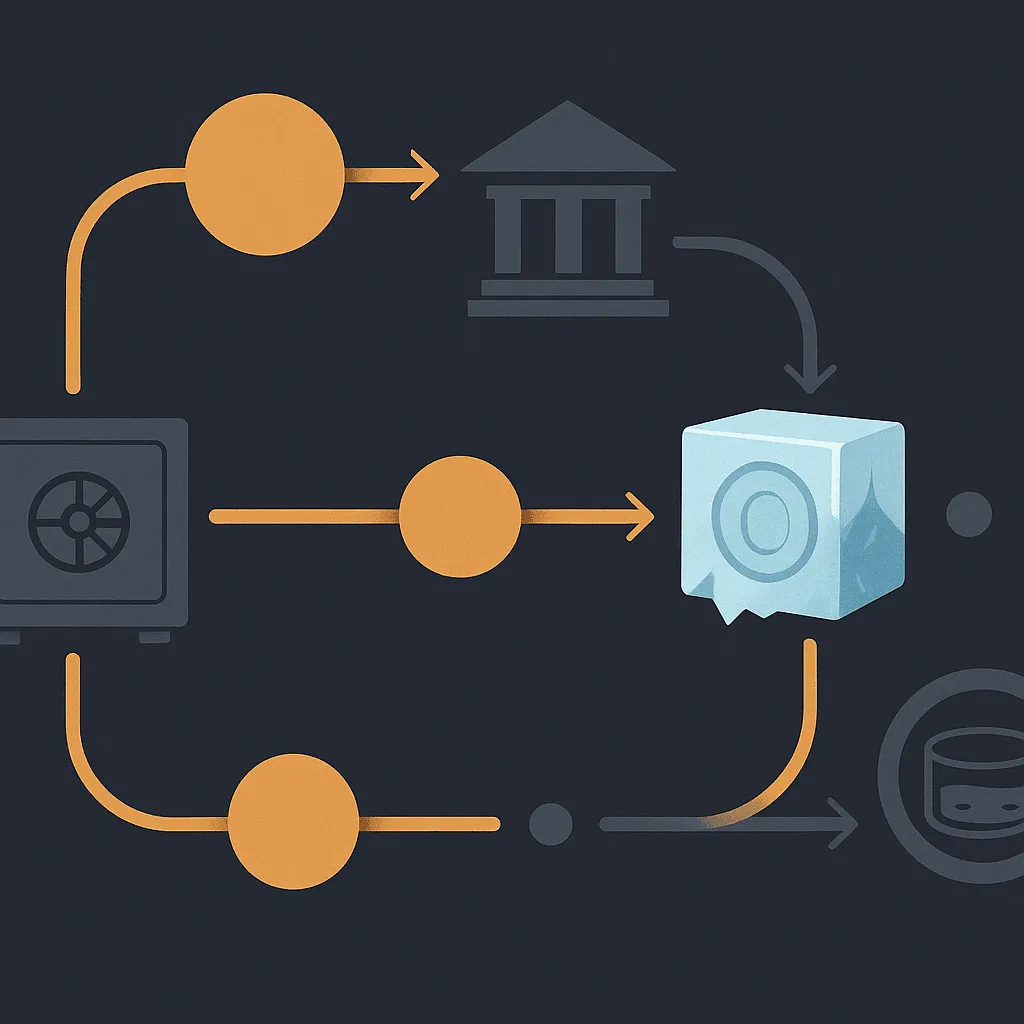
The reported sequence, reconstructed from the public filings and Overnight Finance’s stated allegations, runs roughly as follows. Funds Overnight identifies as misappropriated were swapped into USDC, deposited into Compound v2 to mint cUSDC, and the resulting cUSDC was moved into a contract operated by Zama. Overnight filed suit and obtained a court order directing Circle to freeze the underlying USDC associated with the position. Circle complied. The freeze applied to the USDC balance held by the Compound cUSDC contract corresponding to the disputed deposit — or, more precisely, prevented USDC transfers in a way that locked the redemption path for the cUSDC holdings sitting in the Zama address.
The mechanical detail that matters: cUSDC is not a one-to-one wrapper. It is a pooled receipt token. When a user deposits USDC into Compound v2, the protocol mints cUSDC at the current exchange rate, and the deposited USDC enters a single pool that backs all cUSDC in circulation. When a user redeems, they burn cUSDC and receive USDC from the pool. The pool is fungible. There is no separate vault per depositor.
This means a freeze applied to the Compound cUSDC pool does not surgically isolate one depositor’s claim. It reduces the redeemable USDC available to every cUSDC holder. If $12.6 million of USDC in the pool is frozen, the pool’s effective reserve falls by that amount, and the cUSDC exchange rate — the ratio of pool USDC to outstanding cUSDC — is impaired for everyone holding the token.
In practice the freeze appears to have been scoped to the specific balance corresponding to the disputed deposit rather than collapsing the entire pool, and the precise enforcement mechanism Circle used remains a matter of public reporting rather than disclosed contract calls. But the architectural point holds: a freeze targeting one party’s economic interest, applied at the token layer of a pooled receipt-token system, cannot help but touch the pool.
The party-of-interest problem
Zama is the address-of-record holder of the cUSDC. The funds, as alleged, do not belong to Zama in any meaningful sense — the protocol is described in reporting as having ended up in the position by virtue of how its on-chain operations route. Compound, the protocol whose contract mints and burns the wrapper, is similarly not a party to the underlying dispute. Both are simply contracts that the disputed value passed through.
Traditional asset-freeze orders contemplate this scenario. A court can issue garnishment orders against banks holding a defendant’s funds, and the bank’s other depositors are unaffected because the bank’s books are segregated by accountholder. The DeFi analog does not exist by default. A pooled wrapper has no per-depositor accounting at the token layer. The court order, executed against the token, lands on the pool.
Propagation through composable DeFi

The Zama incident illustrates a class of risk that has been latent in every DeFi position denominated in centralized stablecoins. We can sketch the propagation in layers.
Layer 1 — direct holding. A user holds USDC in their own EOA. A blacklist applied to that address freezes the user’s balance and nothing else. This is the textbook case: surgical, narrow, and largely uncontroversial when applied to clearly bad actors.
Layer 2 — single-protocol deposit. A user deposits USDC into a lending protocol or AMM. The deposit lives in a pool with other users’ deposits. If the user’s withdrawal address is later blacklisted, they cannot withdraw. The protocol’s pool is not directly affected; other users redeem normally. But if the blacklist is applied to the pool contract itself — as can happen when the disputed funds become commingled and a court orders the freeze at the pool’s address — every depositor’s redemption is impaired.
Layer 3 — wrapped derivative. A user holds a receipt token (cUSDC, aUSDC, sDAI’s USDC backing) whose underlying is held by a protocol contract. A freeze applied to the underlying USDC at the protocol’s address affects the receipt token’s redeemability proportionally. The receipt token is itself transferable and may circulate in third-party protocols, where its value has now silently declined.
Layer 4 — second-degree composition. The receipt token from Layer 3 is used as collateral in another lending market, or supplied to an AMM, or wrapped again into a yield-bearing token. The impairment at Layer 3 propagates as accounting drift through every layer above. Liquidations may trigger on positions that were healthy yesterday. AMM LPs may experience impermanent loss against a now-discounted asset that the oracle still prices at par.
The Zama freeze appears to have been contained at Layer 3 in practical terms, but the architectural possibility of escalation is what should hold researchers’ attention. There is no governance lever inside Compound, Aave, Morpho, or any other major money market that can isolate a frozen sub-balance from the rest of the pool. The pooled-accounting design is load-bearing for capital efficiency and was not built with adversarial token-layer interventions in mind.
What “credibly neutral” means here
Vitalik Buterin’s framing of credible neutrality — that infrastructure should be designed so that its rules cannot be selectively bent in favor of one party — was developed in the context of base layers and public goods funding. DeFi has often borrowed the phrase to describe its own ambitions, particularly around lending markets and DEXs. The Zama case forces a precise question: a protocol can be credibly neutral in its own logic and still inherit non-neutrality from its denomination. Compound did not freeze anything. Compound cannot freeze anything. Yet Compound’s pool was impaired by an external action it could neither contest nor route around.
The neutrality of a protocol denominated in USDC is bounded above by the neutrality of USDC.
The legal-mechanical interface

What makes the Zama freeze interesting beyond its immediate facts is that it sits at the interface between two systems with different assumptions about how custody and identity work.
Civil procedure, as it applies to asset freezes, assumes that funds have an identifiable holder, that the holder owes a duty of care to the party freezing them, and that the freeze can be unwound through the normal litigation process. A garnishment order against a bank is straightforward because the bank knows who owns what.
Token contracts assume that funds have an address, that the address is the holder, and that the contract owner — when one exists — can act on that address with no further inquiry. The blacklist is binary: an address either is or is not on the list. There is no field for “frozen pending litigation, subject to pro-rata release to non-defendant beneficiaries”.
When a court orders Circle to freeze funds at an address, Circle’s compliance obligation is to the court. Circle does not have visibility into who else holds claims against the contract at that address. Circle does not have a mechanism to refund the non-party beneficiaries of a pooled position. The blacklist call goes through; the downstream accounting becomes someone else’s problem.
This is not a critique of Circle’s compliance posture, which is a function of the legal regime it operates under. It is an observation about the interface. DeFi protocols that integrate USDC inherit not only Circle’s compliance authority but the granularity at which that authority is exercised — which is the address, not the beneficial interest.
Comparison: USDT, PYUSD, and the issuer landscape
Tether has historically been more aggressive in using its destroy-funds capability, often in coordination with law enforcement after major exploits. PYUSD, being newer and smaller in circulation, has had fewer occasions to exercise its freeze authority publicly. The mechanical capability across the major fiat-backed stablecoins is broadly similar; the policy and frequency of use differ.
Decentralized alternatives — DAI in its current form, crvUSD, GHO, USDS — have different censorship profiles. DAI’s USDC-backed portion inherits USDC’s censorability for that fraction of its collateral. crvUSD, backed by crypto collateral, does not have an issuer-level blacklist. The tradeoff is the one DeFi has debated since 2020: collateral that is not censorable is also more volatile and more capital-intensive, which translates to less attractive borrowing economics and smaller addressable scale. Until that tradeoff shifts, USDC will remain the reserve asset for most large pools, and the Zama-class of incident will remain a structural possibility.
What the cUSDC holders inherit
Set aside Zama and Overnight for a moment and consider the position of an unrelated cUSDC holder who had no involvement with either party. Before the freeze, their cUSDC was a claim on a pro-rata share of a USDC pool whose nominal balance backed the wrapper at a known exchange rate. After the freeze, their cUSDC is a claim on the same pool with a smaller usable balance. The token’s redemption mechanics still function for the unfrozen portion, but the implicit guarantee — that the wrapper is fully redeemable at the protocol exchange rate — has degraded.
How does the market price this? In practice, partial freezes of this size against multi-hundred-million-dollar pools have not produced visible discounts on the receipt token, because the impaired fraction is small and the legal process is expected to resolve. But the precedent is what matters. A receipt token’s value is now understood to be conditional on no party in the chain of past depositors being subject to a court order whose enforcement passes through the pool.
This is a risk that does not appear on any protocol’s risk dashboard. It is not a smart contract risk, not an oracle risk, not a liquidity risk in any standard sense. It is a denomination risk: the asset that backs the pool can be partially impaired by actions taken against the pool’s address by the asset’s issuer, on instructions from a third-party legal authority, regarding a fourth-party dispute. There is no on-chain disclosure of pending freezes. There is no mechanism for affected protocols to subscribe to notifications. The first signal is the failed transaction.
Implications and open questions

The Zama freeze does not change anything fundamental about USDC. The blacklist has been in the contract since deployment, and the propagation risk has been understood, at least in principle, by researchers who have looked at the code. What the incident does is move the risk from theoretical to documented, with a specific dollar figure and a specific protocol that did nothing wrong and still ended up holding the bag.
Several open questions follow.
First, what is the appropriate response at the protocol layer? Compound, Aave, and other money markets could in principle add mechanisms to isolate frozen balances — a “compliance vault” pattern where flagged deposits are siloed from the main pool. But siloing requires the protocol to know, at deposit time, which funds are likely to be flagged later, which is not knowable. The alternative is to maintain a buffer reserve that absorbs freeze impacts, which is a capital tax on every depositor to subsidize the rare event. Neither option is attractive, and neither has been implemented at scale.
Second, does the receipt token need to disclose its exposure? A user holding cUSDC, aUSDC, or any similar wrapper today has no on-chain way to verify that none of the underlying is frozen. A transparency primitive — a function that returns the frozen fraction of the underlying pool — would let downstream protocols and users price the risk. No major wrapper currently exposes this.
Third, what is the threshold at which DeFi diversifies away from USDC denomination? The current concentration is rational under the assumption that freeze events remain small relative to pool size and rare relative to deposit duration. If the frequency or size of freeze actions scales — whether through expanded sanctions enforcement, broader use of civil asset-freeze orders against on-chain funds, or both — the cost-benefit calculation shifts. Decentralized stablecoins, multi-collateral baskets, and tokenized treasuries each offer partial substitutes, each with their own tradeoffs.
Fourth, and most uncomfortably, the Zama incident is a small case. The cUSDC pool absorbed a $12.6 million freeze without observable stress. The relevant question is what happens when a freeze order targets a balance that represents a material fraction of a pool — five percent, ten percent, more. The propagation that was invisible at this scale becomes a liquidity event at a larger one. We do not know where that threshold sits because the experiment has not been run.
What we can say is that the assumption underpinning much of DeFi’s growth — that USDC, while issuer-controlled in principle, behaves as neutral infrastructure in practice — has acquired a footnote. The footnote reads: except when it does not, and you may not be the party the freeze is aimed at.
Read next

The Won Goes Onchain: Korea's Race Ahead of the Rulebook
Korea's won-stablecoin consortiums formed before the law did: the Digital Asset Basic Act stalled on a Bank of Korea demand for bank-majority issuers.

The Missing Rulebook: Why CLARITY Stalled in the Senate
Passed in July 2025, CLARITY sat at Senate Calendar No. 423 past July 2026 over ethics, Section 604, and stablecoin yield.

Custody for Machines: Who Holds the Agent's Keys
MoonPay launched the Open Wallet Standard in March 2026, but agent wallets still split on where policy is enforced: on-chain or via vendor API.