
Introduction
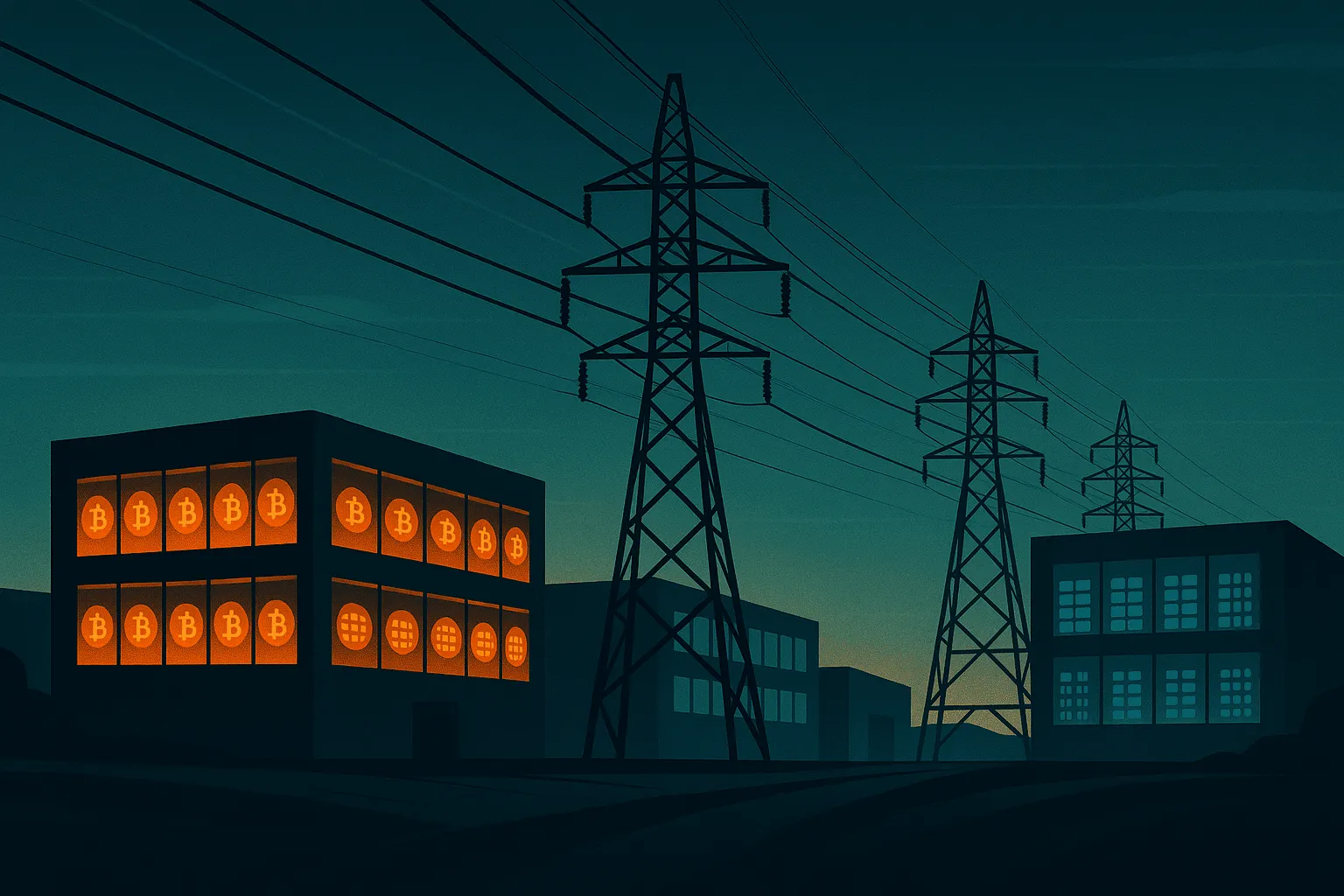
The public Bitcoin mining industry is in the middle of a business-model change so large it is easier to describe as an exit than a pivot. Companies that spent the last cycle building hashrate at any cost are now paying to retire it. Core Scientific is delivering hundreds of megawatts to CoreWeave, TeraWulf has locked in ~$12.8B in HPC contracts, and Hut 8 signed a 15-year, $7.0B lease with Fluidstack at its River Bend, Louisiana campus, backstopped by Google. Across the listed sector, cumulative AI and HPC contract announcements now exceed $70B.
At the same time, network hashrate has retreated from a peak of roughly 1,160 EH/s in early October 2025 to a 7-day SMA of 969 EH/s on April 13, 2026 — the first sustained multi-adjustment decline since July 2022. Hashprice bottomed near $28–$30 per PH/s/day in early March 2026 and has only partially recovered to $33.25 by mid-April. Transaction fees produced 0.58% of block rewards in the week ending April 13.
The question this article works through is not whether the miner AI pivot is happening — the contract stack settles that — but what it changes about Bitcoin’s security assumptions. Bitcoin’s security is a function of miner revenue, and miner revenue is a function of subsidy plus fees. The 2028 halving will cut the subsidy again. If the marginal power buyer at large industrial sites is now a hyperscaler rather than a miner, the energy input floor for hashrate is being repriced structurally rather than cyclically. That has second-order consequences for anything built on Bitcoin as a settlement layer — BTCFi lending, layer-2 bridges, wrapped-BTC systems — where security assumptions were implicitly underwritten by a much larger and more profitable miner base than currently exists.
The balance-sheet signal that broke the model

The pivot did not begin with a strategic epiphany. It began with a spreadsheet. Per CoinShares’ Q1 2026 mining report, the weighted average cash cost to produce one bitcoin among publicly listed miners rose to approximately $79,995 in Q4 2025. Bitcoin traded in the $68,000–$70,000 range through that period, meaning the public mining industry was, in aggregate, cash-flow negative by roughly $19,000 per coin produced.
That number requires care. CoinShares’ figure covers publicly listed miners only, and the methodology’s exact treatment of depreciation, SG&A, and interest is not fully spelled out in the excerpts available to us. Private miners — who hold an unquantified but substantial share of global hashrate — likely operate on materially different cost structures, particularly in jurisdictions with lower power costs. But for the listed cohort, the direction is unambiguous. At 25–38 J/TH fleet efficiency, revenue per MWh was $42 on April 13; at 19–25 J/TH, $61; only sub-19 J/TH fleets cleared $79/MWh. Miners paying more than $50–$60/MWh for power at meaningful volume have been underwater on marginal blocks for months.
Two responses to that pressure are visible in the disclosures. The first is treasury liquidation. Public miners collectively sold more than 15,000 BTC from peak treasury levels, with specific sales including Core Scientific’s ~1,900 BTC (~$175M), Riot’s 1,818 BTC (~$162M), and Bitdeer reducing to zero. Marathon disclosed 53,822 BTC in its March 10-K, expanded treasury sales authorization, and saw the LTV on its bitcoin-backed credit facility climb to 87% as BTC fell toward $68,000 — a level at which further downside would have triggered margin risk.
The second response is debt at scale. IREN has issued $3.7B in convertible notes, TeraWulf carries $5.7B in total debt, and Cipher Digital placed $1.7B in senior secured notes. These are not the balance sheets of speculative mining operators; they are infrastructure balance sheets. The capital is not being raised to buy ASICs. It is being raised to build datacenters that no longer mine.
The pivot in contract stack

The public disclosures now form a coherent deal book. Rather than reciting them chronologically, it is worth grouping them by the shape of the transaction, because the shape tells us what the industry is actually selling.
Anchor tenant leases
Hut 8’s River Bend transaction, announced December 17, 2025, is the cleanest example of the model. A 15-year triple-net lease for 245 MW of IT capacity to Fluidstack, with Google providing a financial backstop covering lease payments and pass-through obligations for the full base term. Contract value is $7.0B over the base term, expanding to as much as $17.7B with renewals; Fluidstack holds a ROFO on up to an additional 1,000 MW at future campus phases. Expected average annual NOI is around $454M once fully operational. Project financing is expected at up to 85% LTC, led by J.P. Morgan with Goldman Sachs as co-underwriter. First data hall commissioning is targeted for Q2 2027.
The salient features: single named counterparty, investment-grade credit support, long-duration lease, high-LTC project finance. This is a real-estate transaction with power delivery as the underlying asset. It is not a mining business.
Multi-site HPC colocation
Core Scientific’s CoreWeave partnerships span approximately 590 MW of critical IT load across six sites, with contracted revenue reported in the ~$10–12B range. Applied Digital signed 15-year leases with CoreWeave for 400 MW in North Dakota at ~$11B contracted revenue. Cipher Digital, which has exited most Bitcoin mining operations, carries a $9.3B HPC backlog anchored by a 300 MW AWS deal and a separate Google-backstopped Fluidstack agreement.
Hybrid pivots
TeraWulf has secured $12.8B in HPC contracts across Fluidstack and Core42 deals, targeting sites with more than 1 GW of available power. IREN projects HPC at 71% of revenue by year-end and holds a 4.5 GW power pipeline alongside a Microsoft AI cloud partnership. Core Scientific’s AI colocation revenue reached 39% of total revenue by the time of CoinDesk’s late-March analysis; TeraWulf was at 27%.
Two aggregate figures matter here. The first is the $70B+ cumulative contract stack — a headline number that should be treated carefully, since it represents multi-year total contract value across deals at various stages of execution, not near-term binding revenue. The second is CoinShares’ estimate that listed miners could derive up to 70% of revenue from AI by end-2026, up from roughly 30% at the time of writing. That mix shift, if it lands anywhere near projections, is not a diversification. It is a change of industry.
The reason miners won these contracts
The counterintuitive point is that the miners were positioned to win these deals precisely because of what mining taught them. Years of permitting large power loads, negotiating interconnection with utilities, siting substations, dissipating heat at industrial scale, and running 24/7 high-uptime operations produced a skill set that traditional datacenter developers were slower to replicate. When hyperscalers went shopping for gigawatts on short timelines, the miners had shovel-ready sites and existing utility relationships. The pivot is not the miners entering a new business so much as their power-and-real-estate operating model being reclassified by the market.
Hashrate in retreat
The network metrics reflect the industry’s capital reallocation with a lag but without ambiguity. Hashrate peaked at approximately 1,160 EH/s in early October 2025. By late March 2026 it had fallen to around 920 EH/s, and as of April 13, 2026, the 7-day SMA sat at 969 EH/s with the 30-day SMA at 977 EH/s. In between, the network posted three consecutive negative difficulty adjustments — the first such streak since July 2022. The April 3 adjustment was +3.87% to 138.97T, and the next was estimated at -3.66%.
Hashprice tracked the same trajectory. It bottomed at $28–$30 per PH/s/day in early March 2026 and recovered modestly to $33.25 by April 13. The Luxor hashrate forward curve prices average hashprice at roughly $32.10/PH/s/day through September 2026 — meaning the derivatives market is not expecting a meaningful recovery on any near-term horizon. That is a market view that current conditions are the new baseline, not an anomaly to be mean-reverted.
Two mechanisms are worth naming clearly.
Difficulty as self-healing. When hashrate declines, the next difficulty adjustment reduces the work required per block proportionally, so remaining miners earn more BTC per unit of compute. This is Bitcoin’s built-in stabilizer, and it is why the network does not spiral when hashrate contracts. A 20% hashrate reduction paired with a 20% difficulty reduction leaves surviving miners economically whole in BTC terms. But this is an economic equilibrium for survivors, not a restoration of absolute security. The cost of assembling a majority of hashrate falls in step with the hashrate itself.
Hashprice as the aggregate margin signal. Hashprice compresses BTC price, subsidy, fees, and difficulty into a single revenue-per-PH/day number. When hashprice sits below the all-in electricity cost per PH for a fleet, that fleet is bleeding cash on every block. The revenue-per-MWh table above translates directly: a fleet at 25–38 J/TH earning $42/MWh cannot survive against power at $50/MWh, and the operator’s rational move is either to shut off the rigs or to redeploy the power to a tenant who pays more per MWh. AI tenants do.
The security-budget identity

Bitcoin’s per-block security budget is the sum of two components: the block subsidy, currently 3.125 BTC, and transaction fees. The subsidy halves roughly every four years. The next halving, expected in 2028, drops it to 1.5625 BTC. For total miner revenue in BTC terms to hold constant across a halving, fees have to double their absolute contribution. For revenue to grow, they have to more than double.
Where do fees stand now? In the week ending April 13, 2026, transaction fees produced 0.58% of block rewards — approximately 16 BTC in total fees for the week, worth around $1.2M. On a per-block basis, that is roughly 0.0163 BTC in fees against a 3.125 BTC subsidy. Fees are a rounding error in current miner revenue.
The forward math is uncomfortable. If the 2028 halving arrives with fees at anywhere near current share of rewards, the aggregate BTC-denominated revenue paid to miners in that first post-halving epoch is essentially halved. Whether that translates into a proportional hashrate contraction depends on BTC price and on how much of the current miner base is already effectively out of the market via AI conversion. If a meaningful share of listed miner capacity has migrated to HPC leases and is no longer available to be redeployed at low marginal cost, the price elasticity of hashrate on the upside also weakens. In prior cycles, higher BTC prices summoned new hashrate back within months. In this cycle, the sites and interconnections that would have been repurposed for that response are under 15-year triple-net leases.
The mechanism that has historically been assumed to backfill the subsidy — a robust fee market driven by base-layer transaction demand — has not materialized on the required scale. Fees are episodic. They spike during ordinals waves, bull-market congestion, and periods of high on-chain settlement, and they collapse in between. A steady-state fee market at the level required to replace even half of the post-2028 subsidy is not visible in current data. That does not mean it cannot emerge; it means it has not.
Where the counterargument holds
There is a real case that the current picture overstates the risk. CoinShares’ hashrate forecast projects 1.8 ZH/s by end-2026 and 2 ZH/s by end-Q1 2027 — but this projection is explicitly conditional on BTC recovering to roughly $100,000. At that price, mining economics for efficient fleets normalize, and the hashrate contraction reads as a cyclical response to a price drawdown rather than a structural exit. Prior halving cycles all featured temporary hashrate dips followed by new highs. Non-pivoting operators — MARA, Riot, CleanSpark — are maintaining or expanding mining, and new geographic entrants (Paraguay, Ethiopia) are entering the global top ten as U.S.-listed capacity redeploys. The base is diversifying, not necessarily shrinking.
The pivot itself also carries execution risk that cuts in the opposite direction. Hut 8’s first River Bend revenue is not scheduled until Q2 2027 at earliest. Contracts announced as binding may include LOIs and conditional agreements not yet at definitive documentation. Infrastructure-scale debt loads — $3.7B, $5.7B, $1.7B on individual balance sheets — leave miners exposed if hyperscaler demand cools, financing terms tighten, or construction delays push revenue recognition further out. A liquidity crisis at a pivoting miner could force fire-sale disposals that briefly restore hashrate before further destabilizing the sector.
Cyclical or structural?

The important question is whether the AI pivot represents a cyclical margin response — miners renting out capacity while mining is unprofitable, ready to redeploy if hashprice recovers — or a structural repricing of the energy inputs that mining depends on. The evidence in the research pack leans toward structural, with meaningful qualifications.
The capex differential is the strongest structural signal. AI infrastructure runs $8M–$15M per MW to build; Bitcoin mining infrastructure runs $700K–$1M per MW. A site converted to AI has ten to twenty times the capital sunk into its physical build-out compared to the same site as a mining facility. The opportunity cost of tearing that out to redeploy ASICs is not symmetric. Once liquid cooling, high-density power distribution, and multi-tier redundancy have been installed to hyperscaler specification, reverting to mining wastes most of that capital and forgoes the tenant revenue that justified it.
The lease structures reinforce the asymmetry. A 15-year triple-net lease with investment-grade credit backstop is not a facility a miner can casually reclaim in year three because BTC hit $150,000. Contractual duration compounds the physical irreversibility of the buildout.
The energy market implication follows. In power markets where hyperscalers are actively bidding for gigawatt-scale interconnections — ERCOT, MISO, PJM, the Louisiana Entergy footprint — the marginal buyer of large industrial power at mining-viable sites is now the AI tenant, not the miner. That does not raise the wholesale price of electricity everywhere; it raises the reservation price at the specific sites where hashrate had been concentrated. The research pack does not give us a market-by-market breakdown of how much AI demand has repriced these specific interconnection queues, and that is a gap worth flagging. But the direction is consistent across the disclosures we can see.
There are two hedges to this thesis. The first is that private and international miners — Paraguay, Ethiopia, jurisdictions with stranded hydro or gas — face a different power cost curve and different competitive dynamics. Their capacity does not compete for the same interconnection queues as U.S. hyperscaler AI. Global hashrate may migrate rather than disappear. The second is that a large enough BTC price move can still overwhelm the economics: if hashprice rose to levels seen in the 2021 cycle, even converted sites might justify hybrid GPU/ASIC deployments. Neither hedge invalidates the structural argument; both moderate its severity.
What it changes for BTCFi
BTCFi — the ecosystem of layer-2s, wrapped-BTC bridges, on-chain lending, restaking-style constructions, and DeFi settlement rails that treat Bitcoin as either the reserve asset or the ultimate settlement layer — is built on a set of assumptions about the base layer’s security. Those assumptions include a level of hashrate at which reorganizing recent blocks is economically prohibitive for any attacker below sovereign scale, and a fee market that can sustain that hashrate as the subsidy declines. Neither assumption is being violated today. Both are being pressured.
For protocols that finalize based on block confirmations — bridges that release funds after N blocks, lending protocols that treat deep confirmations as settlement — the cost of a reorganization is directly a function of aggregate miner revenue. If revenue contracts, the cost of assembling a majority of hashrate contracts with it. Difficulty adjustment neutralizes this on the operator side (survivors earn more per PH), but not on the attacker side, because the attacker’s cost to acquire hashrate is denominated in the same reduced revenue terms. We are not near a threshold that the sources we have can identify with precision — that is one of the research gaps — but the direction of travel is toward tighter margins of security, not looser ones.
The subtler consequence is on incentive alignment. Miners have historically been long-term-aligned participants in the network’s success. A miner with a large BTC treasury, ASICs with multi-year depreciation schedules, and operating expenses paid in fiat has every reason to want the base layer to succeed. A miner that has sold most of its BTC treasury to fund a 15-year AI lease with a hyperscaler counterparty is a different kind of participant. Its economic future does not depend on Bitcoin. Its remaining hashrate is a residual, not a strategic asset.
That is not necessarily a security problem; hashrate does not require ideological alignment to secure the network, only economic rationality. But it changes who the swing capacity is. The marginal miner going forward is more likely to be an operator whose primary business is elsewhere, whose ASIC deployment is a hedge against AI capacity utilization, and whose willingness to remain in mining depends on tight, near-term margins rather than a long-cycle thesis on BTC price.
Implications and open questions
The current data supports a narrower claim than the strongest version of the security-budget alarm, and a broader claim than the sanguine version.
The narrow claim: over a 6–12 month horizon, difficulty adjustment and the possibility of BTC price recovery leave the network’s security posture largely intact. Hashrate at 969 EH/s is historically extremely high, transaction throughput is unimpaired, and the fee thinness that produces $1.2M weekly revenue for miners does not by itself endanger settlement finality on any near-term timeline.
The broader claim: the 2028 halving arrives on a miner base that is smaller, more concentrated in operators with divided attention, more indebted at the infrastructure level, less able to redeploy sites back into mining, and less exposed to BTC price upside via treasury. If the fee market has not begun to structurally thicken by that point — through BTCFi transaction demand, layer-2 settlement flows, ordinals-like base-layer activity, or some category we cannot yet name — then the post-halving security budget question stops being academic and starts being a live operational risk for anything built on top.
Several questions are worth watching over the next 12–24 months.
- The pace at which announced HPC contracts convert into recognized revenue. Hut 8’s Q2 2027 first data hall is a data point; slippage across the sector would tighten balance-sheet stress and could force partial hashrate dispositions at unattractive prices.
- Whether fee revenue as a share of block rewards trends higher during the next period of base-layer congestion. The 0.58% number for the week of April 13 is a single week, not a trend, but a fee market that spikes and returns to near-zero rather than establishing a higher floor is different from one that steps up.
- How aggressively private and international miners fill capacity vacated by U.S. listed operators. Geographic diversification is a legitimate offset to the U.S. AI-driven contraction; the degree matters.
- Whether the 2028 halving triggers a second wave of pivots. If subsidy compression cuts revenue further, and if AI demand at that point still exceeds mining-competitive power prices at large sites, the remaining public mining capacity would face the same decision Core Scientific, TeraWulf, and Hut 8 have already made.
- The BTC price at which conversion becomes even partially reversible. Given the capex asymmetry and lease durations, this may be a higher number than intuition suggests.
None of this describes an imminent failure. It describes a structural drift. Bitcoin’s security has always rested on the assumption that the entities producing hashrate would find it more profitable to defend the chain than to walk away from it. For most of the network’s history, that was true because mining was the only economically rational use of the specific mix of cheap power, large interconnections, and industrial operational skill that miners had accumulated. In 2025 and 2026, that stopped being true. Whether the fee market grows into the gap left by miners choosing AI, or whether the network settles into a lower-security equilibrium supported by a smaller and less committed base, is the question the industry will spend the next halving cycle answering.
Read next

[BTCFi Series 9] Babylon: TVL Up, Yields Thin
Babylon secures ~$5.6B in native BTC with a token worth ~$78M. The unit economics of Bitcoin security-as-a-service, and why realized yield stays thin.

Eleven Charters, 83 Days: Crypto Becomes the Bank
Eleven firms sought OCC trust charters in 83 days. What the charter permits, why GENIUS forces it, and what the consolidation costs.

BIP-360 and the Bitcoin Coins That Cannot Move
Bitcoin's post-quantum migration requires signing with vulnerable keys, and the most exposed coins belong to owners who cannot sign.